
News
Embryo timing flags missing chromosomes but misses trisomies, 11,915-blastocyst study finds
· IVF Automation News
Summary
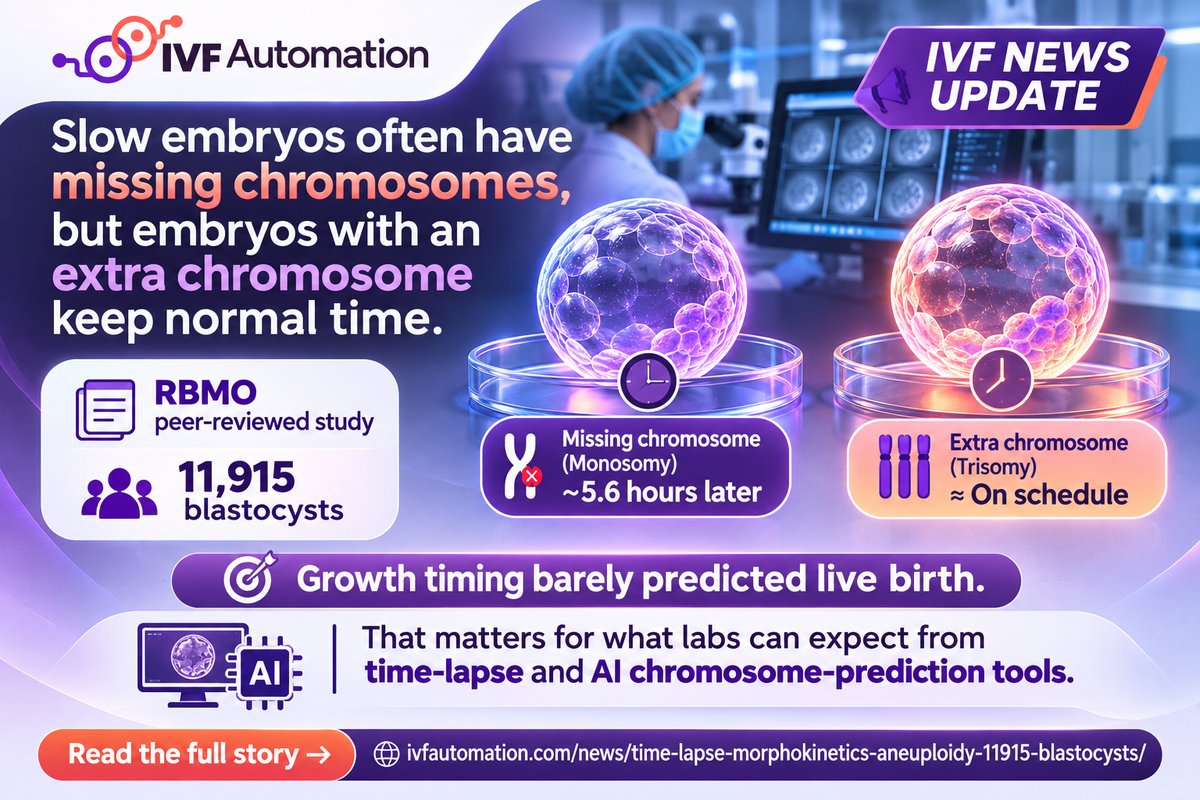
A retrospective study of 11,915 biopsied blastocysts from four Eugin Group clinics, published online in Reproductive BioMedicine Online, found that embryos missing chromosomes develop progressively later than euploid embryos, while embryos with extra chromosomes keep near-normal timing. Developmental trajectory barely predicted pregnancy or live birth. The authors conclude that morphokinetics cannot tell trisomic from euploid embryos.
Slow embryos are more often missing a chromosome. Embryos with an extra chromosome usually keep normal time. That is the main finding of a large new time-lapse study of biopsied embryos. It matters for any lab that uses embryo timing, or an AI score built on it, as a stand-in for chromosome testing.
What did the study look at?
Researchers from Eugin Group in Barcelona and Huntington Medicina Reprodutiva in São Paulo, working with Koç University in Istanbul, reviewed 11,915 blastocysts. The embryos came from 2,917 patients and 3,044 PGT-A cycles at four clinics between January 2019 and July 2024. Each embryo had been filmed in a time-lapse incubator and tested by PGT-A, so the team could compare developmental timing with chromosome results.
The patients were relatively older: mean oocyte age was 38.9 years and 40.1% of blastocysts were euploid. The design was retrospective and the data are confidential.
What is morphokinetics, in plain terms?
Time-lapse incubators photograph each embryo at regular intervals. From these images, embryologists record when key events happen, such as each cell division and the time to a full blastocyst (called tB). This timing record is called morphokinetics. Many embryo-ranking algorithms, including AI tools, learn from these patterns.
Which embryos developed more slowly?
Across the whole group, aneuploid embryos fell behind euploid embryos step by step. By full blastocyst they were 3.66 hours later on average. The size of the delay depended on the kind of error:
- One or two extra chromosomes (gains): about 1.3 to 1.4 hours later.
- One missing chromosome (single loss): 3.47 hours later.
- Two missing chromosomes: 5.56 hours later.
- Multiple abnormalities: 5.64 hours later.
The team grouped embryos into five growth patterns: accelerated, steady, accelerated-to-delayed, steady-to-delayed and delayed. Losses and complex errors gathered in the slower groups. Gains were spread evenly across all five. Losses of gene-rich and non-acrocentric chromosomes caused the longest delays.
Single-chromosome errors that cannot lead to a live birth were less common among accelerated embryos (odds ratio 0.81) and more common in the slower patterns (odds ratios 1.22 to 1.45). Errors that can be compatible with live birth, such as some trisomies, showed no consistent difference from euploid embryos.
Did growth pattern predict a baby?
Not in a useful way. After single euploid embryo transfer, growth pattern was not consistently linked to biochemical pregnancy or live birth. Its ability to tell outcomes apart was very small (Tjur R² of 0.005 and 0.009).
In the authors’ words, morphokinetic analysis “may capture severe chromosomal imbalances but cannot distinguish trisomic from euploid embryos or stratify euploid embryo outcomes.”
What does this mean for embryologists and lab managers?
- Timing is a filter, not a test. A late embryo is more likely to carry a severe loss. A well-timed embryo is not proven euploid, because trisomies keep normal time.
- Check what an AI score is trained on. If a tool predicts ploidy mainly from timing, this study suggests it will miss many trisomies. A 2025 paper in the same journal reached a similar view, titled “trisomies fly under the radar”.
- Keep consent and reports honest. Patient material should not describe time-lapse ranking as a replacement for PGT-A.
- Value time-lapse for what it does well. Undisturbed culture, a complete image record and consistent scoring are workflow gains that do not depend on ploidy prediction. Our time-lapse incubator evidence and buyer’s guide covers these trade-offs.
How does this fit with other recent evidence?
The finding adds to a run of cautious results on non-invasive embryo assessment. In a 2024 randomised trial in Nature Medicine (1,066 patients, 14 clinics), a deep learning score based on time-lapse images did not show non-inferiority to standard morphology for clinical pregnancy (46.5% vs 48.2%). It did cut day-5 assessment time about ten-fold. This week we also reported a blinded study in which non-invasive PGT-A added little beyond morphology.
What is the angle for Indian and global clinics?
Time-lapse systems and AI scoring are available to Indian IVF labs, often marketed with embryo-selection claims. For owners comparing quotes, this study suggests asking vendors for data on which error types a tool detects, and how it performs in older patients, rather than a single headline accuracy figure. Our guide to how FDA and CDSCO view AI embryo assessment explains the regulatory side. Globally, the results support using morphokinetics alongside, not instead of, validated genetic testing where testing is indicated.
What is the commercial outlook?
For time-lapse and AI vendors, the case is likely to rest more on workflow, consistency and data capture than on non-invasive ploidy claims. Tools that pair imaging with other inputs will need independent, prospective validation broken down by error type. Embryo assessment and AI are recurring themes at upcoming meetings listed on our IVF events calendar.
What are the limits?
The study was retrospective, used one clinic group’s protocols and had an older patient mix. PGT-A results from a trophectoderm biopsy can also misclassify some embryos. The data are not public.
Sources
- Quintana-Vehí A, et al. Morphokinetic trajectories of 11,915 blastocysts reveal aneuploidy-specific effects on preimplantation development. Reproductive BioMedicine Online, online 12 Nov 2026 (Crossref record). https://doi.org/10.1016/j.rbmo.2026.106073
- Roman IC, et al. Limitations of ploidy prediction by time-lapse morphokinetics and artificial-intelligence-based embryo selection algorithms: trisomies fly under the radar. Reproductive BioMedicine Online, 2025. https://doi.org/10.1016/j.rbmo.2025.104828
- Illingworth PJ, et al. Deep learning versus manual morphology-based embryo selection in IVF: a randomized, double-blind noninferiority trial. Nature Medicine, 9 Aug 2024. https://doi.org/10.1038/s41591-024-03166-5
- Association between non-invasive PGT-A and live birth in donor oocyte cycles. Fertility and Sterility, online 10 Nov 2026. https://doi.org/10.1016/j.fertnstert.2026.11.006
Tags: time-lapse imaging, morphokinetics, aneuploidy, PGT-A, AI embryo selection, embryology lab, IVF research
Information only, not medical advice.