
AI embryo selection: what metabolomics, time-lapse and machine learning really offer the IVF lab
13 November 2026 · IVF Automation · 7 min read
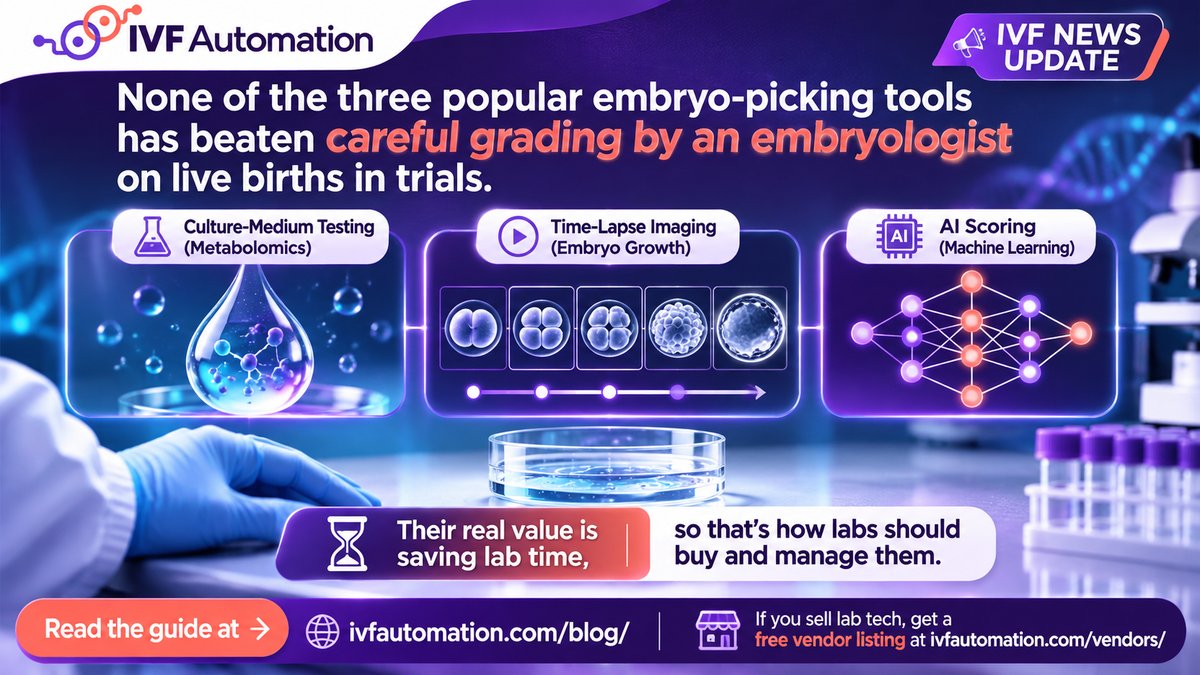
None of the three “intelligent” embryo selection tools, metabolomics, time-lapse morphokinetics or AI scoring, has yet been shown in randomised trials to raise live birth rates over careful morphology by an embryologist. Their proven value today is operational: undisturbed culture, consistent and faster assessment, and better data. Buy and govern them on that basis.
That is the useful tension behind “The Intelligent Embryo Lab: Metabolomics, Morphodynamics & Machine Learning”, a concurrent session at ASPIRE 2027 in Yokohama. Vendors pitch all three as ways to “pick the best embryo”. The trial evidence tells a lab manager something more precise, and more useful when writing a purchase case.
What is the “Intelligent Embryo Lab” session at ASPIRE 2027?
It is Concurrent Session 2 of the main congress programme, scheduled for 10:15–11:45 on the opening morning. ASPIRE 2027, the congress of the Asia Pacific Initiative on Reproduction, runs from 6 to 9 May 2027 at PACIFICO Yokohama North, Japan. The session sits alongside sessions on endometriosis and the future of fertility; the full talk list is on the official ASPIRE 2027 programme. We track the congress and other Indian and global meetings on our IVF events calendar.
The three words in the title map onto three generations of embryo assessment technology:
| Approach | What it measures | Best evidence so far |
|---|---|---|
| Metabolomics | Chemical “fingerprint” of spent culture medium | Cochrane review, 4 RCTs, 924 women: no meaningful difference in live birth or ongoing pregnancy |
| Morphodynamics (time-lapse) | Timing of cell divisions and developmental events from continuous imaging | TILT trial, 1,575 participants: no significant increase in live birth |
| Machine learning | Algorithmic score from embryo images or time-lapse video | RCT, 1,066 patients: non-inferiority to morphology not shown |
Does metabolomic embryo assessment work?
Not on current evidence. The Cochrane review by Siristatidis et al. (2018) pooled four randomised trials of 924 women that compared metabolomic profiling with morphology alone. It found low-quality evidence of little or no difference in live birth or ongoing pregnancy (OR 1.02, 95% CI 0.77 to 1.35). All four trials used the same near-infrared spectroscopy system and algorithm, and two reported higher cycle cancellation in the metabolomics arm. No trial assessed oocyte quality or endometrial receptivity.
The idea has not gone away, because spent medium is non-invasive and cheap to collect. But a lab that is offered a metabolomics add-on today should ask for live-birth data from a randomised trial, not correlations with blastocyst grade.
Is time-lapse imaging worth it for an IVF lab?
For workflow and culture stability, often yes; as a way to improve live birth rates, no. The TILT trial (The Lancet, 2024) randomised 1,575 participants at seven centres in the UK and Hong Kong and concluded that time-lapse imaging for culture and selection “does not significantly increase the odds of live birth compared with standard care”.
ESHRE's 2023 good practice recommendations on add-ons do not recommend time-lapse imaging as a tool to improve live birth rates, and note that embryo selection algorithms appear to be laboratory dependent. The UK regulator, the HFEA, rates time-lapse black (no effect) for improving the chance of a baby for most patients, with manual or algorithm-based analysis.
What time-lapse does give you is fewer incubator openings, an image record of every embryo, and annotation data you can audit. ESHRE's 2020 time-lapse good practice recommendations cover how to annotate consistently. Our time-lapse incubator buyer's guide goes deeper.
Is AI embryo selection better than an embryologist?
Not proven. The largest randomised trial, Illingworth et al. in Nature Medicine (2024), randomised 1,066 patients across 14 clinics in Australia and Europe to selection by a deep-learning tool (iDAScore) or by standard morphology. Clinical pregnancy rates were 46.5% and 48.2%, and the trial could not show non-inferiority against its 5% margin.
The same trial did show a clear operational gain: in a timed subset, day-5 evaluation took a mean of 21.3 seconds with the AI tool versus 208.3 seconds manually, roughly ten times faster. That is the honest pitch for machine learning in the embryology lab today, consistency and speed, with a human still making and signing the decision.
How should an Indian lab evaluate “intelligent” embryo tools?
Treat them as lab infrastructure with a data and governance burden, not as a success-rate upgrade. Before signing, ask the vendor and your own team:
- What is the claim, exactly? Workflow, consistency or live birth? Ask for the randomised evidence behind any outcome claim.
- Was it validated on a population and culture system like yours? ESHRE notes algorithms can be lab dependent.
- Which model version is running, and how are updates logged and re-validated?
- Who owns the images and annotations, where are they stored, and how do they fit your patient-data obligations? See our AI embryo assessment, FDA and CDSCO guide.
- How is the decision recorded? Score, embryologist override and final choice should all sit in the lab record.
- What will patients be told? Marketing that says a tool “improves success rates” is not supported by the trials above.
Our free KPI calculator helps you set a baseline before any new tool goes live, so you can tell later whether anything changed.
Frequently asked questions
When is the Intelligent Embryo Lab session at ASPIRE 2027?
It is listed as Concurrent Session 2, 10:15–11:45 on the opening morning of the main congress. ASPIRE 2027 runs 6–9 May 2027 at PACIFICO Yokohama North, Japan.
What is morphodynamics in embryology?
It refers to tracking how an embryo's shape and cell divisions change over time, usually with time-lapse imaging, so timings can be annotated and fed into selection models.
Does time-lapse imaging improve IVF live birth rates?
The TILT randomised trial of 1,575 participants found no significant increase in live birth, and ESHRE does not recommend it for that purpose. Its benefits are mainly in undisturbed culture and data.
Is metabolomics used for embryo selection today?
It has been trialled, but a Cochrane review of four randomised trials found no meaningful difference in live birth or ongoing pregnancy compared with morphology alone.
Sources
- ASPIRE 2027. Congress programme (Concurrent Session 2: The Intelligent Embryo Lab: Metabolomics, Morphodynamics & Machine Learning).
- Siristatidis CS et al. Metabolomics for improving pregnancy outcomes in women undergoing assisted reproductive technologies. Cochrane Database of Systematic Reviews, 2018.
- Bhide P et al. TILT trial: time-lapse imaging for embryo culture and selection. The Lancet, 2024.
- Illingworth PJ et al. Deep learning versus manual morphology-based embryo selection in IVF: a randomized, double-blind noninferiority trial. Nature Medicine, 2024.
- ESHRE Add-ons Working Group. Good practice recommendations on add-ons in reproductive medicine. Human Reproduction, 2023.
- ESHRE Working Group on Time-lapse Technology. Good practice recommendations for the use of time-lapse technology. Human Reproduction Open, 2020.
- HFEA. Time-lapse imaging and incubation (add-on rating).
Your next step
Sell time-lapse, AI or lab-data systems in India? Claim a free vendor listing so lab managers can find you when they shortlist.
General operational information only; not medical advice and no claim about clinical outcomes. Session details are as published by ASPIRE on 13 November 2026 and may change. See our disclaimer.