
AI oocyte quality assessment: what the evidence says for IVF labs
Published 31 October 2026 · IVF Automation · AI in the embryology lab
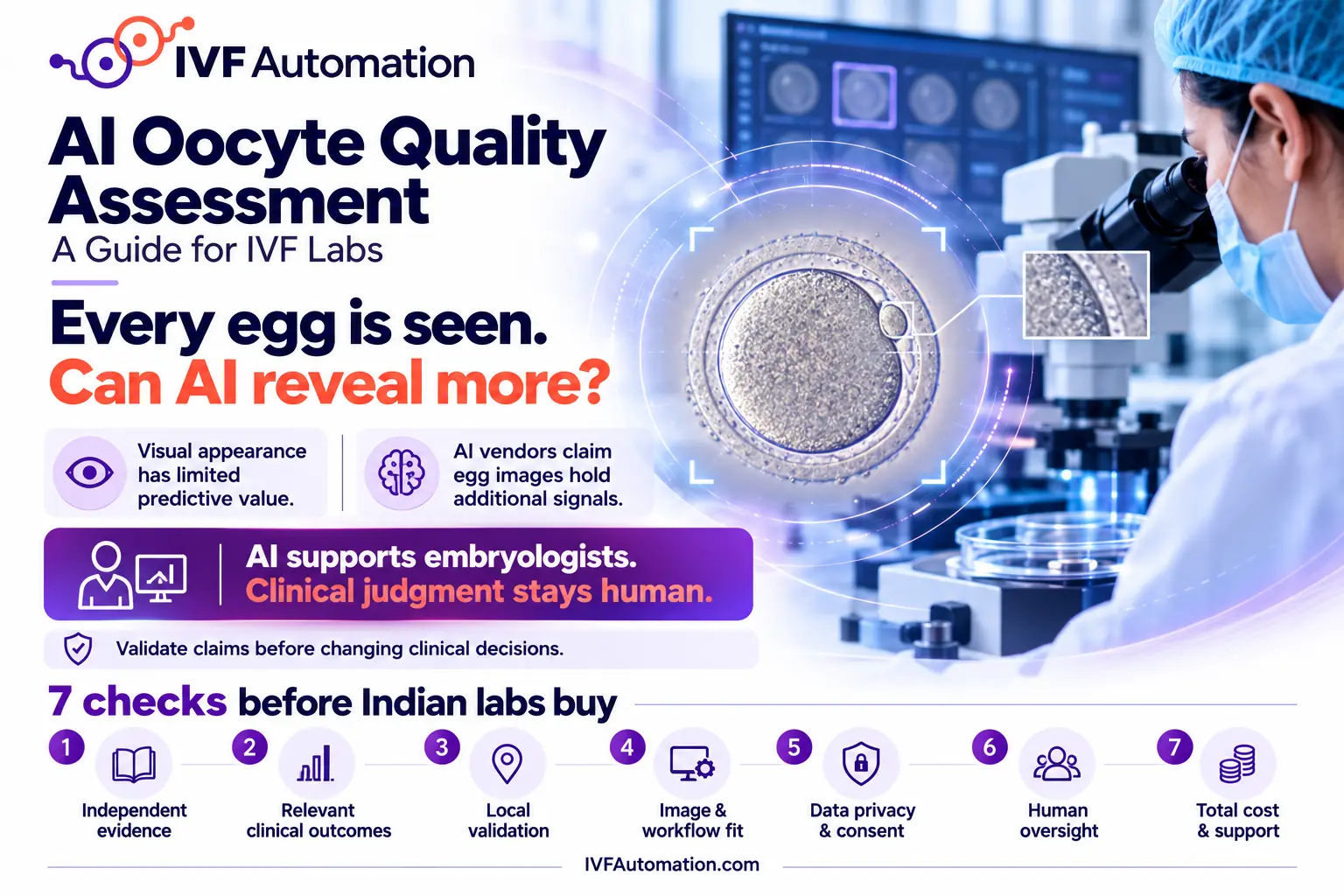
AI oocyte quality assessment uses software to score a standard microscope image of a mature egg and estimate its chance of becoming a blastocyst. Published studies show a real but modest signal, with AUC values around 0.63 to 0.64 in the main development study. ESHRE and ALPHA's 2025 consensus still treats AI as a promising aid, not a replacement for the embryologist.
Oocyte grading is one of the weakest links in lab assessment. Embryologists look at every MII egg before ICSI, yet most of what they see predicts very little. AI vendors say a photo of that same egg holds information the human eye misses. Here is what the evidence supports, where it stops, and what an Indian lab should check before signing up.
What is AI oocyte quality assessment?
It is image-analysis software that gives each mature oocyte a score linked to its developmental potential. The lab takes a 2D light-microscope image of each denuded MII oocyte, typically before ICSI or vitrification, and uploads it. A deep learning model trained on images with known lab outcomes returns a score. In Future Fertility's MAGENTA, the score runs from 0 to 10. The method is non-invasive: it uses an image the lab can already capture and does not touch the egg.
Why is manual oocyte grading so limited?
Because few visible oocyte features are proven to predict outcomes. The 2011 Istanbul consensus listed intracytoplasmic dysmorphisms (such as vacuoles, refractile bodies and smooth ER aggregates) and extracytoplasmic ones (polar body, perivitelline space, zona). The 2025 Istanbul consensus update, which has 20 recommendations, re-reviewed the evidence and found it only supports excluding giant oocytes from clinical use. Its oocyte consensus points are:
- Giant oocytes should be excluded from clinical use.
- Use of small/large oocytes and IVM-rescued oocytes should be documented for prognosis and traceability.
- Embryos from MII oocytes free of large or multiple vacuoles, SER aggregates, disproportional shapes and very large first polar bodies should be prioritised.
So manual grading mostly flags a few problems rather than ranking eggs. That gap is what AI tools aim to fill.
What do studies show about AI oocyte assessment?
The models detect a signal, but discrimination is modest.
| Study | Data | Key result |
|---|---|---|
| Fjeldstad et al., Reprod Biomed Online, 2024 | 37,133 static oocyte images from 8 clinics in 6 countries; external validation on 12,357 images from 2 clinics | Blastocyst prediction AUC 0.64 on test data and 0.63 on external data; higher scores correlated with blastocyst development and quality |
| Pons Ballester et al., ESHRE 2023 abstract (Hum Reprod) | 1,313 fresh MII oocytes from 126 subjects, patients and donors, Valencia | Oocytes that formed blastocysts had higher mean MAGENTA scores (4.8 vs 4.0) |
| Setti et al., F&S Science, 2026 | 13,370 oocytes from 2,196 ICSI patients at one centre | Score linked to fertilisation, blastulation and euploidy; MAGENTA alone predicted euploidy with AUC 0.542, rising to 0.666 when combined with embryo morphology and clinical variables |
For context, an AUC of 0.5 is a coin toss and 1.0 is perfect. In the Setti study, female age was the strongest negative factor for the score. In plain terms, the score adds information on top of age and embryo grading, but it does not sort eggs into "good" and "bad" with certainty. Note that the first and third studies list Future Fertility scientists among the authors, and the second is a conference abstract rather than a full paper.
What are MAGENTA and VIOLET?
They are Future Fertility's two oocyte AI products: MAGENTA for IVF cycles and VIOLET for egg freezing. According to the company, VIOLET reports give egg-freezing patients a record of mature eggs frozen, egg images, per-egg blastocyst predictions and a personalised live-birth estimate for the cohort. The company states its oocyte software has the CE Mark plus UK and Health Canada approval. Those are manufacturer statements, and approvals in one country do not carry over to another.
Can AI replace the embryologist?
No, not on current evidence. Discussing AI for embryo assessment, the 2025 Istanbul update says AI holds great promise to augment embryologist assessment but should not yet be considered a replacement for conventional assessment. Its practice survey (833 responses) found only 14% of respondents used AI, in most cases for time-lapse embryo assessment. A 2025 RBMO review on IVF lab standardisation adds that validation on diverse, robust datasets will be essential before AI decision-support tools can reliably change routine practice. Treat an oocyte score as one more data point in the record, not a decision.
What should an Indian IVF lab ask before buying?
Ask about regulatory status, validation on populations like yours, workflow fit and data handling.
- Indian regulatory status. Ask for written proof of the product's status with CDSCO. Our AI embryo assessment FDA and CDSCO guide covers how software is treated.
- Validation data. Ask which clinics and countries the model was trained and tested on, whether Indian patients were included, and for full peer-reviewed papers, not only abstracts.
- Imaging requirements. Confirm microscope, magnification and image-capture rules. The VIOLET sample report notes predictions can be affected by suboptimal image quality.
- Workflow time. Imaging every MII egg adds a step between denudation and ICSI or vitrification. Time it on a busy day.
- Data and consent. Images and outcomes leave your lab for cloud analysis. Check where data is stored and how patient consent is recorded.
- Integration. Scores should flow into your IVF EMR or lab software rather than being retyped, and sit alongside time-lapse data if you use it.
- Patient communication. Decide who explains scores to patients, and how, before any report reaches them.
Frequently asked questions
What is AI oocyte quality assessment?
It is software that analyses a standard light-microscope image of a mature (MII) oocyte, usually taken after denudation and before ICSI or freezing, and gives a score linked to the oocyte's chance of reaching the blastocyst stage.
How accurate is AI oocyte assessment?
Modestly. In the 2024 MAGENTA development study the model reached an AUC of 0.64 on test data and 0.63 on external data. A 2026 single-centre study found the score alone predicted euploidy with an AUC of 0.542.
What do MAGENTA and VIOLET do?
Both are Future Fertility products. MAGENTA scores oocytes from 0 to 10 for IVF cycles; VIOLET produces reports for egg-freezing patients with per-egg blastocyst predictions and a cohort live-birth estimate.
Can AI replace the embryologist's oocyte grading?
No. ESHRE and ALPHA's 2025 Istanbul consensus update says, in its discussion of AI for embryo assessment, that AI holds great promise but should not yet be considered a replacement for conventional assessment.
Is AI oocyte assessment approved in India?
We could not confirm a CDSCO approval for any oocyte AI tool. The manufacturer states CE Mark, UK and Health Canada approval for its software, so ask any vendor for written proof of its Indian regulatory status.
Sources
- Fjeldstad J, Qi W, Mercuri N, et al. An artificial intelligence tool predicts blastocyst development from static images of fresh mature oocytes. Reprod Biomed Online 2024 (PubMed 38552566).
- Setti A, Braga D, Del Collado M, Fjeldstad J, et al. Artificial intelligence unlocks oocyte competence: MAGENTA outperforms clinical predictors and boosts euploidy modeling. F S Sci 2026.
- Pons Ballester J, et al. P-217: AI-supported MAGENTA oocyte assessments in patients and oocyte donors. Hum Reprod 2023;38(Suppl 1), ESHRE abstract.
- ESHRE/ALPHA. The Istanbul consensus update: a revised ESHRE/ALPHA consensus on oocyte and embryo static and dynamic morphological assessment. Hum Reprod 2025; and ESHRE's Focus on Reproduction summary.
- Alpha Scientists in Reproductive Medicine and ESHRE SIG Embryology. The Istanbul consensus workshop on embryo assessment. Hum Reprod 2011;26(6):1270–1283.
- Shaping the future of the IVF laboratory: standardization for more predictable outcomes. Reprod Biomed Online 2025.
- Future Fertility, VIOLET for egg freezing and VIOLET reports for clinicians (manufacturer pages).
Your next step
Build AI or imaging tools for IVF labs? Claim a free vendor listing so Indian embryology teams comparing options can find you.
General operational information only; not medical, clinical or legal advice. Product and company names are mentioned for information and are not endorsements. See our disclaimer.