
IVF patient acquisition and retention: ethical clinic practices informed by ESHRE guidance
Published 6 November 2026 · IVF Automation · Clinic operations
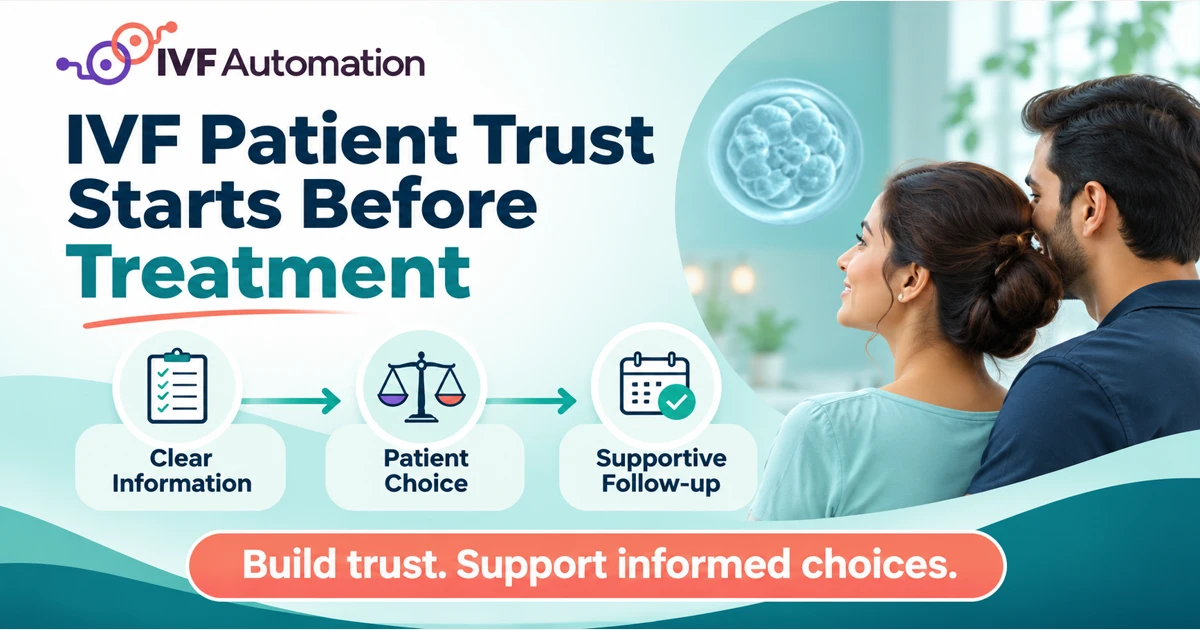
Ethical IVF patient acquisition and retention starts with clear information, shared decisions and continuity of care—not pressure to start, finish or repeat cycles. ESHRE’s published 2015 guide on routine psychosocial care (March 2015; Human Reproduction summary DOI 10.1093/humrep/dev177) tells fertility staff how to support patients before, during and after medically assisted reproduction. It is not a marketing, lead-generation or “repeat customer” playbook. Clinic growth that lasts still follows the same spine: honesty before booking, support through a plan the patient chooses, and respectful follow-up when treatment ends or pauses.
Video transcript
Want more IVF patients? Start with trust, not pressure. Explain choices clearly. Support patients throughout treatment. Follow up respectfully. Discover more at IVF Automation.
On-screen text includes: “IVF patients aren’t leads.” “Inform. Support. Respect.” “Follow up with care. Never pressure.” Ends with the IVF Automation mark.
What ESHRE actually covers (and what it does not)
The guideline Routine psychosocial care in infertility and medically assisted reproduction – A guide for fertility staff was developed for doctors, nurses, embryologists, counsellors and administrative staff. Literature was searched to April 2014; the full staff guide is dated March 2015. The journal summary states that 125 recommendations were formulated, and that only 45 (36%) rested on high-quality evidence; many points are good practice points (GPP) based on expert consensus where robust trials were missing. ESHRE itself notes that adherence does not guarantee a specific clinical outcome.
ESHRE recommendations (care): patient-centred communication; written and personalised treatment information; involvement of both partners where applicable; continuity of care; preparatory information about procedures; needs assessment; referral to specialised counselling when risk is high; space to discuss whether to take up recommended treatment—or not—and the implications of ending unsuccessful treatment.
Our operational suggestions (clinic systems): transparent pricing scripts, consent and privacy controls for messaging, appointment logistics with a human escalation path, and non-clinical automation that never gives medical advice. Where we move from ESHRE to operations, we label it clearly below.
Attract patients with clarity, not urgency
Patients value how staff relate to them, attention to the emotional impact of infertility, involvement of both partners, short waiting times, unhurried consultations and continuity of care (ESHRE preference statements, several graded A). They also value written, understandable, personally relevant information about options and results, plus information about psychosocial support options.
Operational suggestion (not an ESHRE marketing rule): treat your website, counselling pack and first visit as one honest story—what you offer, typical pathway steps, what is unknown, and costs and payment realities before commitment. Financial issues appear among patient-stated reasons for not starting or for discontinuing recommended treatment in evidence summarised by ESHRE (Gameiro et al., 2012, cited in the guideline). Opaque quotes may fill a calendar for a week; they also seed distrust. Keep claims within India’s advertising and ART-related compliance expectations your clinic already follows; use our marketing compliance checklist as an operations aid, not as legal advice.
Help people complete a plan they chose—without forcing completion
ESHRE distinguishes non-compliance via premature discontinuation (stopping despite a favourable prognosis in the studies reviewed) from a shared decision to stop, pause or decline recommended treatment. The guideline reports that about 1 in 10 referred patients choose not to start treatment, and that roughly 1 in 12 and 1 in 5 do not comply with first-line and ART treatment respectively (Brandes et al., 2009; Gameiro et al., 2013—cited grades C/A as in the journal summary). Stated reasons commonly include psychological and physical burden, postponement, financial issues, clinic-related problems and relational factors—not “insufficient follow-up SMS volume.”
On addressing behavioural needs, ESHRE recommends that fertility staff provide preparatory information about medical procedures because it promotes compliance (supporting evidence graded B in the journal summary, citing work such as Pook and Krause, 2005). Preparatory information is also linked to lower infertility-specific anxiety/stress and higher knowledge in related recommendations (grade C). Separately, the guideline development group recommends offering patients the opportunity to discuss uptake or not of recommended treatment and to receive decisional support (GPP). That is the opposite of locking people into a funnel.
Operational suggestion: design reminders and front-desk workflows around the plan the patient already agreed—appointment times, documents, fasting or arrival instructions—while routing distress, prognosis questions and “should we continue?” conversations to a trained human. Do not claim that reminders alone raise completion or pregnancy rates; ESHRE’s compliance-related recommendation is specifically about preparatory information on medical procedures, not marketing nudges. Automation that texts dosing advice or interprets results crosses into unsafe clinical territory. Safe patterns for India-facing messaging and consent are outlined in our WhatsApp front-desk and DPDP rules guide and DPDPA readiness tool.
Anticipate emotional load where ESHRE notes peaks: oocyte retrieval, embryo transfer and the wait for the pregnancy test. Extra psychosocial care and referral to infertility counselling or psychotherapy are recommended when patients are at risk of clinically significant problems (GPP)—including around unsuccessful cycles.
Retention means continuity and respect for stopping
“Retention” in an ethical clinic means patients know who owns their next step, can reach a person, and are not abandoned after a negative test—or after they choose to stop. After unsuccessful treatment, ESHRE’s GDG recommends referring patients who experience or are at risk of clinically significant psychosocial problems to specialised care, offering additional psychosocial support where distress risk is high, and offering patients the opportunity to discuss the implications of ending unsuccessful treatment (GPP). Patient-centred care and positive staff/clinic characteristics are associated with better patient well-being in evidence ESHRE grades C.
Operational suggestion: schedule a structured outcome conversation, document decisions to continue, pause or stop, keep cryostorage and consent status accurate if samples remain stored, and only reopen treatment planning when the patient asks. Long-term “win-back” sequences that push further cycles after a clear stop decision fight the guideline’s decisional-support stance. Continuity of records and handoffs matters here as much as empathy; lab and front-desk systems should agree—see our front-desk playbook and IVF EMR checklist.
Safe automation checklist for Indian clinics
- Do: send logistics reminders the patient opted into; log consent for messaging; escalate emotional or clinical questions to named staff; publish fee ranges and what can change costs; measure respectful completion of agreed steps.
- Don’t: auto-interpret labs, ultrasound or “chances”; buy or blast lead lists without a lawful basis; use chatbots as a substitute for counselling referral; hide add-ons until billing day; optimise only for cycles started or upsold.
Bottom line
Use ESHRE’s 2015 routine psychosocial care guide to raise the floor of daily patient support. Use your operations stack to make that support reliable: transparent costs, privacy-aware communication, human escalation and documentation. Acquisition without honesty, “completion” without choice, or “retention” that ignores a decision to stop are not patient-centred care—and they are not what ESHRE wrote.
Frequently asked questions
Does ESHRE tell clinics how to market or acquire IVF patients?
No. ESHRE’s 2015 routine psychosocial care guideline advises fertility staff on patient-centred support, information and referral. It is not a marketing or lead-generation guide.
What does ESHRE say about patients stopping treatment?
The guideline development group recommends offering patients the opportunity to discuss uptake or not of recommended treatment, and after unsuccessful treatment to discuss the implications of ending care, with referral to specialised psychosocial care when risk is high.
Can appointment reminders be claimed to improve IVF completion rates?
This article does not make that claim. ESHRE links preparatory information about medical procedures with treatment compliance in graded recommendations; that is not the same as marketing reminder campaigns.
Sources
- ESHRE Psychology and Counselling Guideline Development Group. Routine psychosocial care in infertility and medically assisted reproduction – A guide for fertility staff (March 2015). Official page: ESHRE psychosocial care guideline.
- Gameiro S, et al. ESHRE guideline: routine psychosocial care in infertility and medically assisted reproduction—a guide for fertility staff. Human Reproduction (2015). DOI 10.1093/humrep/dev177. Long version PDF hosted by ESHRE.
Your next step
Sell patient-communication, EMR or front-desk tools to Indian IVF clinics? Claim a free vendor listing so operations leads comparing ethical workflow tools can find you.
General operational information only; not medical, clinical or legal advice. ESHRE does not endorse IVF Automation. See our disclaimer.