
IVF lab design guidelines: layout, HVAC and air quality targets
Published 10 November 2026 · IVF Automation · Lab operations
There is no single global rulebook for IVF lab design. Most labs work from two documents: ESHRE’s Revised guidelines for good practice in IVF laboratories (2015), and the 2018 Cairo consensus on the IVF laboratory environment and air quality, which gives numeric targets for particles, VOCs, air changes, pressure, temperature and humidity. In India, the ART (Regulation) Rules, 2022 add a minimum equipment list.
Getting the design right is the cheap part. Keeping a sealed, positively pressurised, low-VOC room in spec every day for years is where labs slip, and that is the part sensors and automated alerts handle well.
What do ESHRE’s guidelines say about IVF lab design?
ESHRE sets principles rather than numbers. Section 3 of the 2015 guideline asks that:
- the lab sits next to the operating room where retrievals and transfers happen;
- construction materials, paint, flooring and furniture suit cleanroom standards and minimise VOC release;
- workflow covers minimal distances, and access is restricted to authorised staff;
- changing rooms, hand-washing, admin offices and any sterilisation area sit outside the lab, and fixatives or toxic reagents are used in a separate room with a fume hood;
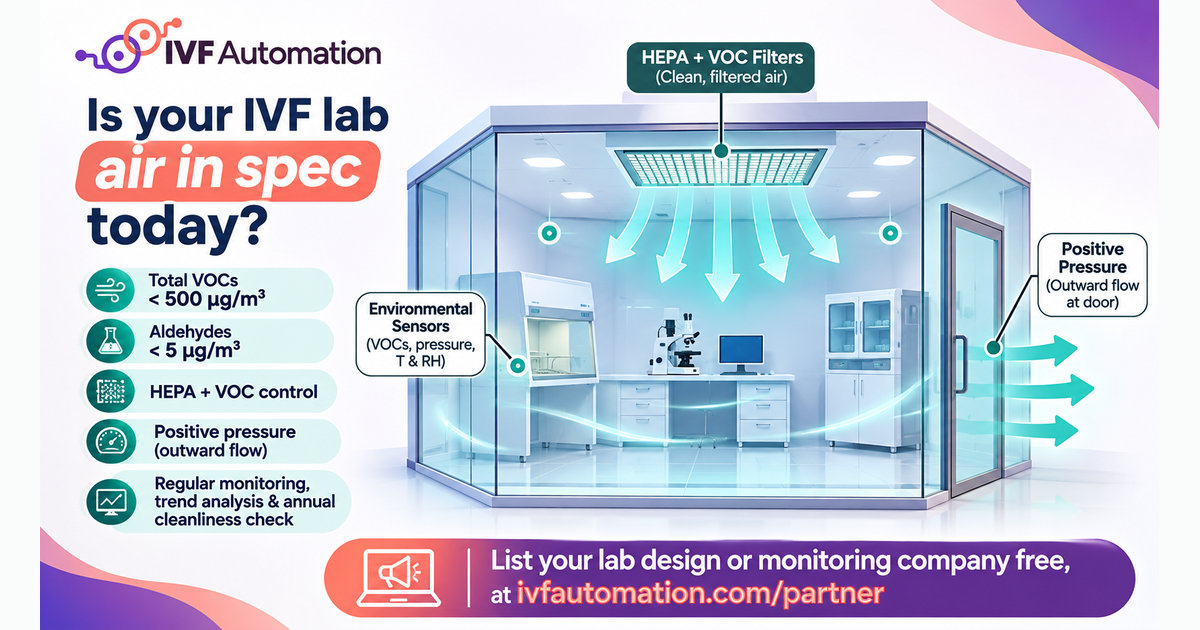
- air is HEPA- and VOC-filtered, with positive pressure recommended and air quality regularly monitored;
- gas cylinders sit outside the lab, with an automatic change-over system.
It also notes the EU Tissues and Cells Directive expectation of a GMP Grade A environment for processing, with at least a Grade D background.
What numeric air-quality targets does the Cairo consensus set?
The Cairo consensus is the most specific public benchmark. Thirteen international experts (Mortimer et al., Reproductive BioMedicine Online, 2018) agreed more than 50 points, framed as guidelines for new labs and aspirational benchmarks for existing ones. They judged the EU Grade D background too loose and aimed for ISO Class 7 / GMP Grade B “in operation” (Grade C “at rest”).
| Parameter | Cairo consensus target |
|---|---|
| Particles (0.5–10 µm) | Fewer than 352,000 per m³ |
| Micro-organisms (at rest) | Fewer than 10 cfu/m³ and fewer than 2 spores/m³ |
| Total VOCs | Below 500 µg/m³; aldehydes below 5 µg/m³ |
| Air changes | 15 per hour, including 3 fresh-air changes (20% outside air) |
| Overpressure | +38 to +50 Pa ideal; +30 Pa minimum |
| Temperature | Stable, typically 20–24°C depending on region |
| Relative humidity | 40–45% |
The panel was candid that level 1 evidence is mostly lacking, because randomising embryos to different air is hard and arguably unethical. Treat these as engineering targets, not outcome guarantees.
How should the HVAC system be built?
Dedicated, always on, sealed and chemically filtered. The consensus recommends:
- a dedicated air handling unit for the ART suite that runs constantly, with at least the HVAC fans on generator back-up;
- an activated carbon or potassium permanganate filter downstream of air handling and before the HEPA filter;
- ductwork cleaned of anti-rust oils off-site, then sealed;
- a “submarine” mode that isolates outside air during smoke, road resurfacing or nearby construction;
- ceiling supply vents and low-level returns, with HEPA filters placed centrally for easier changes.
Which layout and materials keep the lab clean?
Seal the box and keep “dirty” rooms out. Gas cylinders, bulk stores, andrology and endocrine labs, offices, changing rooms and the cryobank (which needs continuous extraction) should sit outside the ART suite. Walls run slab to slab, ceilings are solid rather than tiled, lights are cleanroom-rated, and conduits, doors and pass-throughs are sealed. For finishes, the consensus suggests sheet vinyl floors, non-porous countertops such as epoxy, and powder-coated metal or stainless-steel cabinets. It advises against MDF, linoleum and oil-based paints. Aldehyde-based cold sterilisers should not be used anywhere in the suite.
What does India’s ART Rules 2022 require?
A minimum equipment list, not an HVAC spec. For Level 2 ART clinics, the Rules list a microscope, at least two incubators, laminar airflow, sperm counting chambers, a centrifuge, a refrigerator, cryopreservation equipment, an ovum aspiration pump, an ultrasound machine with transvaginal probe and needle guard, a test tube warmer and an anaesthesia resuscitation trolley. Use our IVF lab equipment list for India and ART Act lab compliance checklist to plan around that floor.
What should an IVF lab monitor automatically?
Anything that can drift out of spec without anyone noticing. The consensus already points to continuous checks: differential pressure across every doorway, pressure drop across HEPA filters, and HVAC servicing at least once a year. A building or lab monitoring system can log and alarm on:
- room differential pressure falling below your set floor (for example, +30 Pa);
- room temperature and humidity leaving your band;
- VOC trend from a photoionisation detector (PID). The consensus notes PIDs are poor at detecting aldehydes, but a rising trend is a useful sign that the carbon filter is exhausted;
- filter pressure drop, so changes follow real load rather than the calendar;
- incubator, gas and cryotank alarms on the same dashboard.
Timestamped logs also become your evidence for audits and inspections. For detail, see our guides to IVF lab VOC monitoring and lab monitoring systems and incubator alarms.
How do you commission a new or renovated IVF lab?
Burn in, deep clean, test, then go live. The Cairo consensus asks for at least 2–3 weeks of off-gassing in the construction schedule, confirmed by specific VOC testing against a baseline rather than a sperm survival test. Every surface then gets a deep clean. After launch, plan for pleated pre-filters at roughly 90-day intervals and HEPA filters every 2–4 years. Change chemical filters based on your own consumption history rather than a fixed date.
Frequently asked questions
Is there an official IVF lab design standard in India?
The ART (Regulation) Rules, 2022 list minimum equipment for ART clinics, including at least two incubators and laminar airflow for Level 2 clinics. They do not set numeric HVAC or air-quality targets in that list, so most designers work from ESHRE’s guideline and the Cairo consensus.
What pressure should an IVF lab run at?
The Cairo consensus sets an ideal of +38 to +50 Pa in the IVF lab, with a recommended minimum of +30 Pa, built up as a cascade through vestibules so neighbouring rooms don’t differ too sharply.
What temperature and humidity suit an IVF lab?
The Cairo consensus suggests a stable 20–24°C, depending on region, and 40–45% relative humidity. Lower humidity speeds evaporation during dish preparation; higher humidity encourages mould.
How long should a new IVF lab off-gas before use?
The Cairo consensus says to allow at least 2–3 weeks of burn-in in the construction schedule, and to confirm it with specific VOC testing against a baseline rather than a sperm survival bioassay.
Sources
- ESHRE Special Interest Group of Embryology. Revised guidelines for good practice in IVF laboratories (2015) (PDF), sections 3.1–3.3; also published in Human Reproduction (2016).
- Mortimer D, Cohen J, Mortimer ST, et al. Cairo consensus on the IVF laboratory environment and air quality: report of an expert meeting. Reproductive BioMedicine Online, 2018 (PubMed).
- Government of India. Assisted Reproductive Technology (Regulation) Rules, 2022 (Gazette PDF), minimum equipment in ART clinics and banks.
Your next step
Design IVF labs, or supply HVAC, cleanroom, VOC filtration or monitoring systems in India? Claim a free vendor listing so clinic owners planning a new lab can find you.
General operational information only; not medical, clinical, engineering or legal advice. Work with a qualified cleanroom engineer and check current regulations for your state. See our disclaimer.