
News
Embryo glue under scrutiny: new data find no gain in frozen embryo transfers
· IVF Automation News
Summary
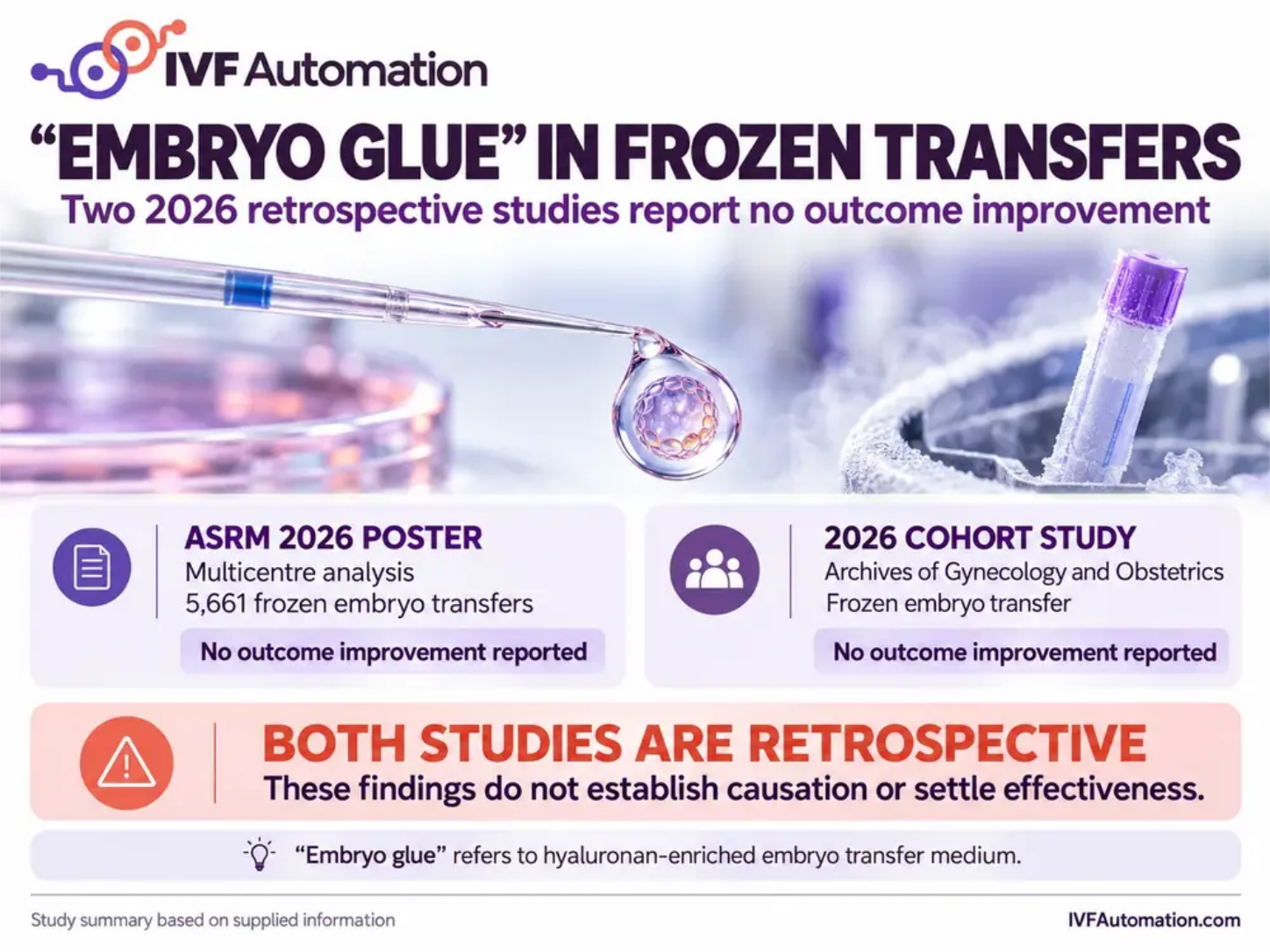
A multicentre poster at ASRM 2026 (5,661 frozen embryo transfers) and a 2026 cohort study in Archives of Gynecology and Obstetrics both found that hyaluronan-enriched transfer medium, often called “embryo glue”, did not improve outcomes in frozen embryo transfer. Both studies are retrospective. Their findings fit a 2026 randomised trial presented at ESHRE, but differ from earlier evidence for fresh transfers. Labs may want to review whether they offer the add-on routinely.
Many IVF clinics offer hyaluronan-enriched transfer medium, sold as EmbryoGlue and often called “embryo glue”, as an add-on at embryo transfer. Two new datasets suggest that in frozen embryo transfer (FET), which is now the most common type of transfer in many labs, it may add cost without adding pregnancies.
What was reported
On 27 October 2026, Ovation Fertility (part of the US Fertility network) announced a poster presented at the ASRM 2026 Scientific Congress in Baltimore (24–28 October). The retrospective multicentre study, titled “High Cost Without Clinical Gain”, covered every FET cycle at two IVF centres from 2022 to 2025, a total of 5,661 cycles. It compared hyaluronan-enriched medium with CSCM-NX, a low-lactate medium supplemented with protein. According to the announcement, the enriched medium “substantially increases cost without improving embryo implantation”. The press release does not give the implantation rates for each group. The full poster data were not available for us to check.
A separate peer-reviewed study by Coştur Filiz and Filiz, published online in Archives of Gynecology and Obstetrics on 13 October 2026, analysed 335 transfer cycles at one university ART unit (June 2025 to April 2026), 87.5% of them frozen. Clinical pregnancy rates were identical: 56.7% with EmbryoGlue (n = 171) and 56.7% with Irvine NX medium (n = 164), with an odds ratio of 1.00 (95% CI 0.65–1.54). Patients and clinicians chose the medium together, so the groups were not randomised. The enriched-medium group also had more patients with two or more previous transfers. Even after adjustment, the medium did not independently predict pregnancy.
The science in plain language
Hyaluronan (hyaluronic acid) occurs naturally in the female reproductive tract. The idea behind adding a high concentration to transfer medium is that the thicker medium may help the embryo stay in place and support its early contact with the endometrium. Ovation's associate laboratory director, Dr Nirvika Singh Sharma, put the doubt simply in the company's release: “embryo glue doesn't actually make the embryo stick to the uterus.” She named embryo quality, euploidy and the uterine lining as the main factors in implantation.
Why the evidence looks mixed
The older evidence is more positive. The 2020 Cochrane review (Heymann et al.) found moderate-certainty evidence from 10 randomised trials (4,066 participants) that high-concentration hyaluronan increased live birth (risk ratio 1.21, 95% CI 1.10–1.31). ESHRE's 2023 good practice recommendations on add-ons judged that the benefit was seen after fresh transfers, with “no effect” seen after frozen transfers. ESHRE recommended the addition, advised labs to keep monitoring multiple-pregnancy rates and to pair it with a single-embryo-transfer policy.
Since then, practice has changed. Single blastocyst transfer and freeze-all cycles are now routine, and much of the earlier trial data came from different settings. A four-centre double-blind randomised trial from China (Cai et al.), presented at ESHRE 2026 in July, randomised 865 women having single fresh or vitrified-warmed blastocyst transfer. It found live birth rates of 51.5% with EmbryoGlue and 47.7% with a standard medium (RR 1.08, 95% CI 0.95–1.23), which was not a significant difference. That trial is still a conference abstract, and its control medium contained some hyaluronan, which may have narrowed the gap.
Limits to keep in mind
- The two October datasets are retrospective, so confounding cannot be ruled out.
- The Ovation data come from a conference poster and a company press release, not a peer-reviewed paper.
- The single-centre study measured clinical pregnancy only, not live birth, and its authors note it could miss smaller differences.
- None of these studies settles whether particular groups, such as patients with repeated implantation failure, might benefit. All the authors call for further randomised trials.
What it means for labs and clinics
Embryologists and lab managers: audit your own data. Compare implantation and clinical pregnancy by transfer medium, separating fresh from frozen and single from double transfers. A simple add-on log in your lab KPI tracking makes this possible without new equipment.
Fertility specialists: when patients ask about the add-on, explain where the evidence stands. The case looks weakest for routine use in frozen single-blastocyst transfers.
Clinic owners: if embryo glue is a line item in FET packages, check that the price and the counselling match current evidence. Regulators and professional bodies increasingly expect add-ons to be presented transparently.
India and global perspective
In India, IVF is often sold as a package and add-ons are a frequent source of cost questions from patients. Clinics registered under the ART (Regulation) Act, 2021 already document consent for each procedure. Clear, evidence-based wording for optional add-ons fits that process. Globally, the trend is towards transparency, from ESHRE's add-on recommendations to clinic-level outcome audits.
Commercial outlook
For media makers, the bar is rising: new claims for transfer additives will likely need randomised, live-birth data in single blastocyst and FET settings. For software and service providers, the opportunity lies in outcome tracking by add-on, an area where many labs still rely on spreadsheets. Watch for the full publication of the ESHRE 2026 trial and the ASRM poster data.
Sources
- Ovation Fertility via EIN Presswire, “Ovation Fertility ‘Embryo Glue’ Research Abstract Selected for Presentation at ASRM 2026”, 27 Oct 2026 (press release; conference poster). https://www.einpresswire.com/article/952358971/ovation-fertility-embryo-glue-research-abstract-selected-for-presentation-at-asrm-2026
- Coştur Filiz P, Filiz S. Hyaluronan-enriched transfer medium in routine clinical practice: a retrospective cohort study…, Archives of Gynecology and Obstetrics, published online 13 Oct 2026 (peer-reviewed). https://doi.org/10.1007/s00404-026-08592-z
- EMJ Reviews, “ESHRE 2026: HA-Enriched Medium Shows No IVF Benefit” (Cai H et al., abstract L26-O-310), 8 Jul 2026 (conference abstract). https://www.emjreviews.com/en-us/amj/reproductive-health/news/eshre-2026-ha-enriched-medium-shows-no-ivf-benefit/
- Cochrane, Heymann D et al. Hyaluronic acid in embryo transfer media for assisted reproductive technologies (CD007421), Sep 2020 (systematic review). https://www.cochrane.org/evidence/CD007421_ivf-does-transferring-embryo-media-containing-high-concentrations-hyaluronic-acid-result-more-live
- ESHRE Add-ons Working Group. Good practice recommendations on add-ons in reproductive medicine, Human Reproduction 2023 (guideline). https://pmc.ncbi.nlm.nih.gov/articles/PMC10628516/
Tags: embryo glue, hyaluronan transfer medium, EmbryoGlue, frozen embryo transfer, IVF add-ons, ASRM 2026, embryology lab, India IVF
Information only, not medical advice.