
AI in the IVF lab: what it does well, what the evidence says, and how Indian clinics should buy it
Published 3 November 2026 · IVF Automation · AI and lab technology
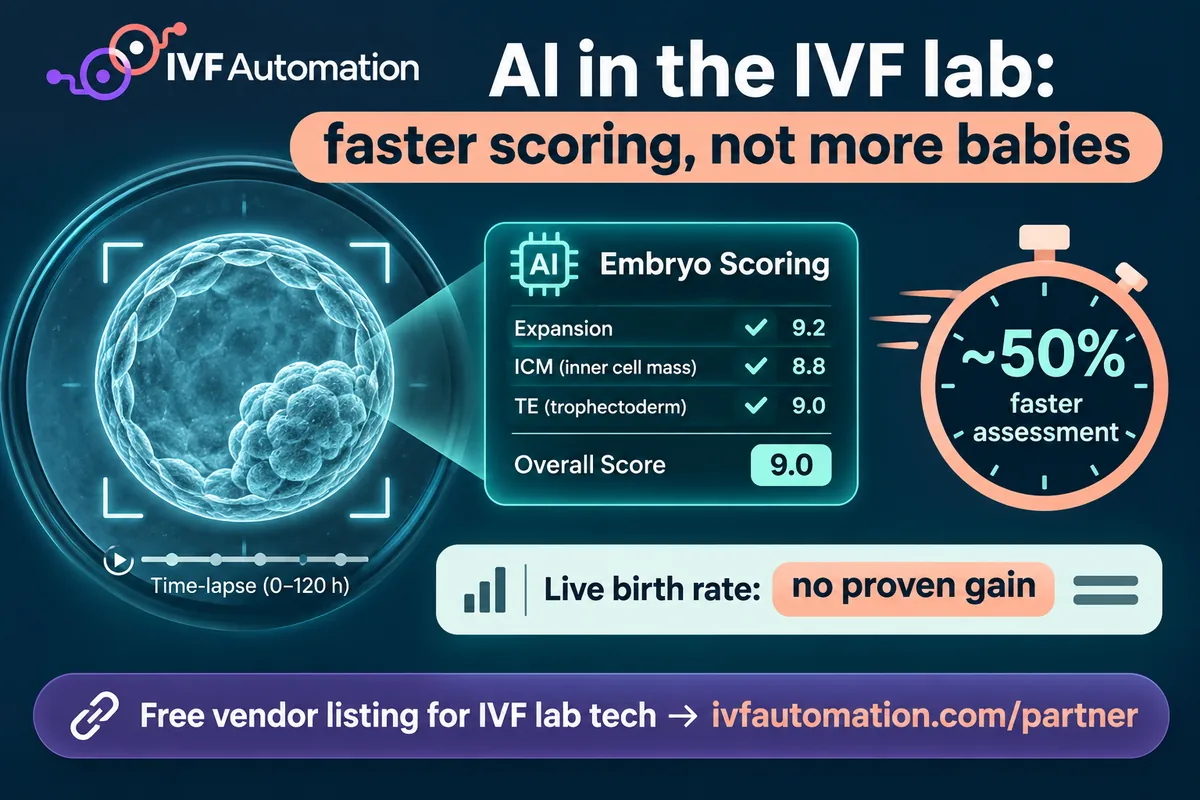
AI in the IVF lab today mostly means software that ranks embryos from time-lapse images, plus automation for witnessing, storage alarms, dashboards and patient messaging. It reliably saves time and makes scoring more consistent. It has not been shown to raise pregnancy or live birth rates, and ESHRE and the UK's HFEA say so plainly.
That gap between the brochure and the evidence is where Indian clinics lose money. A lab can buy AI for the right reasons, such as speed, standardisation and audit trails, or for the wrong one: a promise of more babies that no randomised trial has backed. This guide separates the two, using the trial data, the professional guidance and India's own AI ethics rules.
How is AI used in the IVF lab?
Most lab AI falls into two groups: embryo assessment tools, and operational automation that supports the people doing the work.
| Use | What it does | What it is good for |
|---|---|---|
| Embryo ranking and annotation | Scores embryos from time-lapse image series | Speed, consistency between embryologists, teaching |
| Sample identification and witnessing | Tracks dishes and tubes with barcode or RFID tags | Fewer manual double-checks, a clear audit trail |
| Cryo-storage monitoring | Watches tank levels and temperatures, sends alarms | Faster response out of hours |
| Lab KPIs and reporting | Pulls cycle data into dashboards | Spotting drift before it shows up in results |
| Front-desk and messaging | Booking, reminders and FAQs on WhatsApp | Staff time, fewer missed appointments |
The operational tools are judged on uptime and workflow. The embryo tools carry clinical expectations, so they need the closest look. We cover the operational side in our guides to electronic witnessing and cryo-tank monitoring.
Does AI embryo selection improve IVF results?
Not on the best evidence so far. The largest randomised trial, published in Nature Medicine in 2024 by Illingworth and colleagues, enrolled 1,066 patients across 14 clinics in Australia and Europe. It compared the deep learning algorithm iDAScore with standard morphology assessment.
- Clinical pregnancy was 46.5% (248 of 533) with iDAScore and 48.2% (257 of 533) with morphology.
- The trial could not show non-inferiority against its 5% margin (risk difference −1.7%, 95% CI −7.7 to 4.3).
- Live birth was 39.8% with iDAScore and 43.5% with morphology, a secondary outcome.
- Assessment took 21.3 seconds on average with the algorithm and 208.3 seconds manually.
So the algorithm was about ten times faster, and the trial didn't prove it was as good at picking the embryo that leads to a pregnancy. Both facts matter when you write a business case.
What do ESHRE and the HFEA say about AI and time-lapse?
Both say time-lapse with embryo selection software should not be sold as a way to improve live birth rates. ESHRE's 2023 good practice recommendations on add-ons (Human Reproduction, 42 recommendations) state that time-lapse imaging is not recommended as a tool to improve live birth rates. They add that it still has value for research, teaching, standardising assessment, lab workflow and quality control, and that these uses are not add-ons if patients pay nothing extra.
The HFEA rates time-lapse with automated analysis, meaning algorithms or AI, as "black" for improving the chance of a baby for most patients. That means moderate to high quality evidence shows no effect. The October 2023 consensus statement agreed between the HFEA and other professional and patient bodies says unproven add-ons should only be offered in research settings, and patients should not be charged to take part in research. The ESHRE add-ons paper also notes that the many selection algorithms published so far appear to be laboratory dependent, probably because culture conditions differ. For a deeper look at incubators themselves, see our time-lapse incubator buyer's guide.
What rules apply to AI in Indian IVF clinics?
Two layers matter: device regulation for clinical software, and ICMR's AI ethics guidelines. Software that informs a clinical decision may be a medical device under CDSCO, and we explain how that works next to the FDA route in our AI embryo assessment FDA and CDSCO guide.
The Indian Council of Medical Research published its Ethical Guidelines for Application of Artificial Intelligence in Biomedical Research and Healthcare in 2023. They apply to clinicians, hospitals and developers who use health data with AI, and cover ethical principles, ethics review, governance and informed consent. ICMR calls them a living document that will be updated. For a clinic, the practical message is to know what the tool does, who is accountable for its output, and what patients are told.
How should an Indian clinic evaluate an AI lab tool?
Buy it for the gain you can measure in your own lab, and ask for evidence in writing. Questions worth putting to any vendor:
- What is the regulatory status of this product in India, and for what intended use?
- Is there randomised trial evidence, or only retrospective accuracy studies?
- Was the model trained or validated on data from labs like ours, with our culture conditions?
- Where is patient data stored and processed, and how does that fit DPDP Act duties?
- Can embryologists see and override the score, and is every override logged?
- How will we measure time saved and scoring consistency in the first three months?
Then keep patient communication honest. If the tool speeds up grading, say that. Don't present it as a way to raise success rates, and think carefully before charging extra for it.
Frequently asked questions
How is AI used in IVF?
Mainly to rank embryos from time-lapse images, to automate routine scoring and annotation, and to run operational tasks such as sample witnessing, storage-tank alarms, KPI dashboards and patient messaging. The evidence for each use is different.
Does AI embryo selection improve IVF success rates?
Not on current evidence. The largest randomised trial, published in Nature Medicine in 2024, could not show that the iDAScore algorithm was non-inferior to embryologist morphology for clinical pregnancy, and ESHRE and the HFEA do not recommend time-lapse with selection software as a way to raise live birth rates.
Is AI faster than an embryologist at grading embryos?
In the 2024 iDAScore trial, assessment took 21.3 seconds on average with the algorithm against 208.3 seconds with manual morphology. Speed and consistency are its clearest proven gains.
Is AI in IVF regulated in India?
Software that informs clinical decisions can fall under CDSCO medical device rules, and ICMR's 2023 Ethical Guidelines for AI in Biomedical Research and Healthcare set expectations on validation, accountability, consent and data. Clinics should ask vendors for their regulatory status in writing.
Should clinics charge patients extra for AI embryo selection?
ESHRE's 2023 add-on recommendations say time-lapse functions used for workflow and quality control are not add-ons if patients pay nothing extra, and the October 2023 consensus statement agreed by the HFEA and professional and patient bodies says unproven add-ons belong in research settings without extra charges.
Sources
- Illingworth PJ et al. Deep learning versus manual morphology-based embryo selection in IVF: a randomized, double-blind noninferiority trial. Nature Medicine 30, 3114–3120 (2024).
- ESHRE Add-ons working group. Good practice recommendations on add-ons in reproductive medicine. Human Reproduction 38(11), 2062–2104 (2023).
- ESHRE Working group on Time-lapse technology. Good practice recommendations for the use of time-lapse technology. Human Reproduction Open (2020).
- HFEA. Time-lapse imaging and incubation, treatment add-ons ratings, accessed 3 November 2026.
- HFEA and partners. The responsible use of treatment add-ons in fertility services: a consensus statement, 19 October 2023 (hosted by ESHRE).
- ICMR. Ethical Guidelines for Application of Artificial Intelligence in Biomedical Research and Healthcare, 2023.
Your next step
Build AI, time-lapse or lab automation tools for Indian IVF clinics? Claim a free vendor listing so lab managers comparing options can find you.
General operational information only; not medical, clinical or legal advice. See our disclaimer.