
Blog · By IVF Automation team · 22 Oct 2026
Your LN2 tanks can't phone you at 3 a.m. An automated monitor can.
On one weekend in March 2018, two fertility labs in the United States lost stored eggs and embryos to cryo-storage tank failures. At University Hospitals in Cleveland, more than 4,000 eggs and embryos were affected, and the hospital later said the tank's remote alarm had been switched off, so nobody was alerted as the temperature rose. In San Francisco, a federal jury later awarded nearly $15 million to five Pacific Fertility Center patients after finding the tank maker 90% responsible for a defective controller meant to monitor liquid nitrogen levels.
Neither lab lacked a tank. What failed was the chain from sensor to human. That chain is now an automation problem, and India's ART Rules already ask for it. This guide covers what the rules and guidelines expect, how monitoring technology has moved beyond a simple temperature probe, and how to set up an alert system that actually reaches someone. It is operational information only. Your storage SOPs, alarm set points and emergency plan must be approved by your lab director.
What Indian rules and global guidance expect
Rule 28 of the Assisted Reproductive Technology (Regulation) Rules 2022 sets the storage standards for gametes and embryos. In plain terms, it says:
- Stored material must be kept "under controlled conditions that are validated and monitored" (28.4.1).
- Cryocans "should be fitted with local alarms and be linked to an autodial or similar facility to alert staff to non-conformities outside normal working hours" (28.5).
- The centre needs adequate staff and funding for an on-call system to respond to alarms out of hours, plus spare storage capacity so samples can be moved (28.6).
- There must be procedures for emergencies that damage storage vessels or break storage conditions (28.3), and a backup plan for power failure or fire (28.7).
- Records must show every occasion when gametes and embryos are handled during storage and release, and by whom (28.4.3).
ESHRE says the same thing. Its 2015 good practice guidelines for IVF laboratories state that cryostorage units "should be continuously monitored and equipped with alarm systems, detecting any out of range temperature and/or levels of liquid nitrogen", and that critical equipment needs automatic backup power. The 2026 ESHRE recommendations go further. They ask for alarms that detect and log out-of-range readings, at least one backup tank, qualification of new tanks before clinical use, and periodic checks of tank integrity, vacuum performance and evaporation rates.
The American Society for Reproductive Medicine's 2020 committee opinion on cryostorage is the most detailed. It says every storage tank must be electronically monitored, that alerts should reach staff in the lab and by text or phone call, that there should be a written response plan and phone tree for working and non-working hours, and that alarms should be tested at least quarterly. It also points out that a tank can lose liquid nitrogen through a vacuum failure while the vapour temperature still looks normal for a while.
Why a temperature probe alone is not enough
A temperature alarm tells you a tank is already warming. Research has looked at catching failure earlier by watching how fast liquid nitrogen is used up.
A 2019 study in the Journal of Assisted Reproduction and Genetics put storage dewars on scales and simulated slow, medium and fast nitrogen loss. In the medium-loss scenario, a 10% weight loss happened in about 0.8 hours, while the tank took 3.7 to 4.8 hours to warm to the −185 °C temperature trigger. The weight-based alarm fired roughly three hours before the temperature alarm would have. The authors concluded that weight monitoring could act as a redundant safety layer, not a replacement. Later conference work reported in Fertility and Sterility looked at measuring a tank's outside surface temperature to spot vacuum loss quickly.
This is where software earns its place. Once every tank sends readings to one system, the system can learn each tank's normal daily nitrogen use and flag a tank whose use starts climbing, before any hard limit is crossed. That kind of trend alert is simple pattern-spotting, not magic. Treat any "AI" claim from a vendor as a question to ask: what exactly does it detect, how early, and how was that tested?
Automated storage is already a regulated device category
Automation now reaches past monitoring into storage itself. In November 2022 the US FDA cleared TMRW Life Sciences' CryoRobot Select System (510(k) K221086). FDA describes it as an automated liquid nitrogen storage system for oocytes, embryos and sperm that helps identify, store and retrieve specimens, using RFID-tagged carriers. It is listed under its own FDA product code, "automated cryopreservation storage system". Before buying any system for use in India, ask the supplier about its regulatory status here and who services it locally.
Build an alarm chain that actually reaches someone
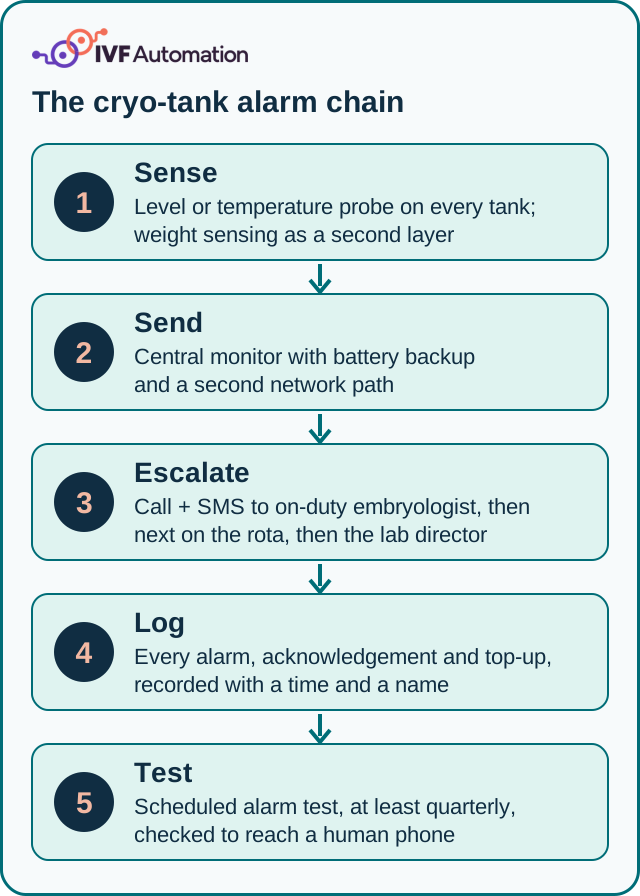
Most of the risk sits in the steps after the sensor. A practical setup has five links:
- Sense. Fit each tank with a level or temperature probe. Consider weight or surface-temperature sensing as a second, independent layer for your highest-value tanks.
- Send. Readings go to a central monitoring system with battery backup and a second network path, so a power cut or Wi-Fi outage doesn't silence it. ASRM specifically warns that alarms must still work when power, phone or internet is down.
- Escalate. An alert goes to the on-duty embryologist by call and SMS. If nobody acknowledges within a set time, it moves to the next person on the rota, then the lab director. Rule 28.5 asks for exactly this kind of autodial alert outside working hours. WhatsApp can be a useful extra channel, but don't rely on a single app.
- Log. Every alarm, acknowledgement, top-up and sample move is recorded with a time and a name. This gives you the handling record Rule 28.4.3 expects and the evidence an inspector will want to see.
- Test. Run a scheduled alarm test, at least quarterly following ASRM, and check that it reached a human phone. Make sure no alarm can be muted without a logged reason and an automatic reminder to switch it back on.
That last point answers the Cleveland lesson directly. Software can make "alarm off" a visible, time-limited state rather than a silent one.
Questions to ask a monitoring vendor
- Which parameters do you measure (level, temperature, weight, surface temperature), and how often?
- How does the system alert out of hours, and what happens when the power or internet fails?
- Can I set an escalation rota, and is every acknowledgement logged?
- Can the system export logs and test records for an ART inspection?
- Where is my data stored, and how does that fit India's Digital Personal Data Protection Act 2023? For help with that, try our free DPDPA readiness check.
- Who services it locally, and what does the AMC cover? Our guide to AMC questions for IVF lab vendors has more.
Sources
- ART (Regulation) Rules 2022, rule 28
- ESHRE Revised guidelines for good practice in IVF laboratories (2015), sections 3.3 and 3.4
- ESHRE Recommendations on Good Practice in the IVF laboratory, Human Reproduction (2026)
- ASRM Practice Committee, Cryostorage of reproductive tissues in the IVF laboratory (2020)
- Early detection of cryostorage tank failure using a weight-based monitoring system, J Assist Reprod Genet 2019
- Vacuum loss of liquid nitrogen tanks can be rapidly detected by measuring outside surface temperature, Fertility and Sterility (conference abstract)
- US FDA 510(k) database, K221086 CryoRobot Select System
- AP News, Fertility clinic: alarm was turned off on failed embryo tank (2018)
- Reuters, Jury awards $15 mln in fertility clinic cryotank failure trial (2021)
Your next step
Run an out-of-hours alarm test this week and time how long it takes to reach a person. If you're comparing monitoring or cryo-storage suppliers, browse our free IVF vendor directory. Suppliers can claim a free listing there too.
For inspection readiness, see our ART Act compliance checklist and daily IVF lab QC logs guide. For more workflow ideas, see the workflow library.
General operational information only; not medical, clinical or legal advice. See our disclaimer.