
IVF cryostorage inventory management: map every straw without risking the tank
Published 5 November 2026 · IVF Automation · Lab operations and automation
IVF cryostorage inventory management is the disciplined record of every oocyte, sperm sample and embryo in the tank—patient and cycle IDs, device labels, exact location, freeze and thaw events, consent status and who handled the sample. ESHRE's 2026 lab recommendations spell out freeze and thaw documentation and call for periodic inventory cross-checks. India's ART Act, 2021 Section 23 requires detailed records of donor gametes and embryos used or unused for at least ten years.
Tank alarms keep nitrogen cold. Inventory keeps identity and location honest. Mix them up and you can prove the dewar was full while still failing the simple question: where is this patient's straw, and who last moved it?
What is IVF cryostorage inventory management?
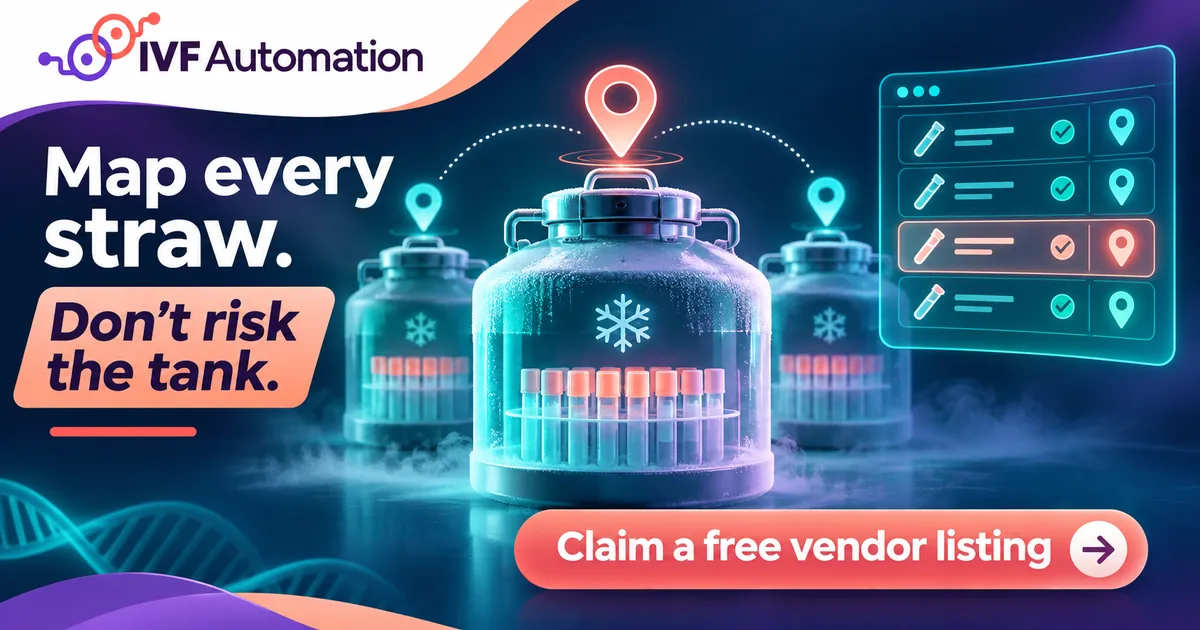
It is the map and ledger for cryopreserved reproductive material—not the LN2 probe. Each device (straw, vial or equivalent) ties to a patient or donor, cycle, tissue type, storage hierarchy (tank → canister → cane/goblet → device), and a history of freeze, relocate, thaw, transfer, discard or ship events. Software only helps if SOPs force every move into the ledger before anyone leaves the LN2 bath. That sits beside—not instead of—cryostorage tank monitoring: monitoring asks whether the tank is safe; inventory asks what is in it and whether you can prove it.
What should every freeze and thaw record include?
ESHRE's 2026 good practice recommendations list a concrete documentation set at freeze and at thaw. At freeze: consent, device labelling, method, date and time, operator, sample quality or stage, count per device, devices per patient, tank/canister location and unique codes (or Single European Code where applicable). At thaw: method, date and time, operator, and post-thaw survival and quality. ESHRE also recommends a documented double-check of patient identity and embryo number when loading devices, depositing into the cryobank and removing material.
ASRM's 2020 cryostorage committee opinion adds a caution: full physical inventories are usually done when needed (suspected loss or record mismatch), not as a casual annual ritual, because vitrified samples warm fast. When required, trained staff plus a witness should work one canister at a time under LN2, with active read-back of two unique patient identifiers.
What does India's ART Act expect from cryo records?
Section 23 of the Assisted Reproductive Technology (Regulation) Act, 2021 requires clinics and banks to keep detailed records of all donor oocytes, sperm or embryos used or unused, and the manner and technique of their use. Keep them at least ten years, then transfer to the National Registry central database (immediately on earlier closure). Make them available for inspection by the National Board, National Registry, State Board or authorised persons, and submit online progress and donor-supply data once the Registry is established.
Section 22 separately requires written consent and specific instructions before cryopreserving embryos or gametes for death or incapacity scenarios. Inventory that cannot show consent next to a stored device leaves a gap even if the tank map looks tidy. See our ART Act lab compliance checklist and National ART Registry portal guide.
How do you structure a tank map that staff will actually use?
Use a fixed hierarchy, permanent labels and one source of truth that updates before the sample moves.
- Hierarchy: tank ID → canister → cane or goblet → device ID. ESHRE expects cryostorage systems organised for easy access and identification of materials inside.
- Labels: clear, permanent device labels tied to unique patient identification; ASRM stresses two unique patient identifiers visible while material stays under LN2.
- Witnessing: treat deposit and removal as critical steps (manual or electronic)—see our lab witnessing guide.
- Disposition: track consent for continued storage, discard, research donation or shipment, with authoriser and date. ASRM lists abandoned-specimen and discard-consent failures among known error sources.
- Lots: link cryo media and device batch numbers to the freeze event for recall tracing.
If you already run an IVF EMR or lab module, keep inventory inside that cycle record—not a parallel spreadsheet. See our IVF EMR software checklist.
Which automation features actually reduce inventory risk?
Features that force a check at the moment of transfer beat dashboards nobody opens. Useful patterns: barcode or RFID on devices, forced witness before a location change saves, soft locks when inventory shows zero devices, storage-period alerts, and exportable audit logs. ESHRE notes that electronic witnessing systems need training, clear alerts, mismatch audits and a validated manual backup—the same applies when EWS feeds the cryobank ledger. Pair inventory software with continuous LN2/temperature monitoring and external tank alarms; telemetry and the ledger solve different failure modes.
How should Indian labs run an inventory audit without warming samples?
Prefer daily desk reconciliation and risk-based physical checks—not heroic annual empties of every cane. Reconcile freezes, thaws, transfers and discards against the ledger before the team leaves. Spot-check during planned thaws with active witnessing under LN2. Escalate to a full physical inventory only for mismatches, suspected loss or after a tank incident—trained staff, a witness, one canister at a time (ASRM 2020). Keep a corrected electronic copy plus a controlled export, and retain records at least ten years under ART Act Section 23 (map any longer ESHRE-style targets against Indian law and clinic policy).
Frequently asked questions
What is IVF cryostorage inventory management?
Software plus SOPs that record what is stored, for whom, on which device and tank location, with freeze/thaw history, consent status and audit trails so every sample can be found and accounted for.
How is inventory different from tank monitoring?
Tank monitoring watches LN2 level, temperature and alarms. Inventory management tracks sample identity, location (tank, canister, cane or goblet, device), counts and disposition. You need both.
What does ESHRE say labs should document at freeze?
Consent, device labelling, method, date and time, operator, quality or stage, counts per device, devices per patient, tank/canister location and unique codes where applicable (ESHRE 2026).
Does India's ART Act require cryo records?
Yes. Section 23 requires detailed records of donor oocytes, sperm and embryos used or unused, including manner and technique of use, for at least ten years, then transfer to the National Registry central database.
Should we do a full physical tank inventory every year?
ASRM (2020) notes annual full physical inventories are not routine because warming risk can outweigh benefit. Do a full inventory when records and tank contents disagree, with trained staff and a witness.
Sources
- ESHRE IVF Labs working group. ESHRE recommendations on Good Practice in the IVF laboratory. Human Reproduction 41(8), 1245 (2026). Cryopreservation documentation and periodic inventory: section 14.
- ASRM Practice Committee / SRBT / SART. Cryostorage of reproductive tissues in the IVF laboratory: a committee opinion. Fertility and Sterility 114:486–91 (2020).
- ART Act, 2021 — Section 23 (record-keeping; source text from India Code via Acts of India). Section 22 covers cryopreservation consent.
- Go KJ. A subspecialty of the assisted reproductive technologies: cryogenic inventory maintenance. Journal of Assisted Reproduction and Genetics (2019).
Your next step
Sell cryostorage inventory, witnessing or lab software to Indian IVF clinics? Claim a free vendor listing so lab managers comparing tank-map and audit tools can find you.
General operational information only; not medical, clinical or legal advice. See our disclaimer.