
Novelties in embryo culture: single-step vs sequential media, low oxygen and culture QC for lab managers
14 November 2026 · IVF Automation · 6 min read
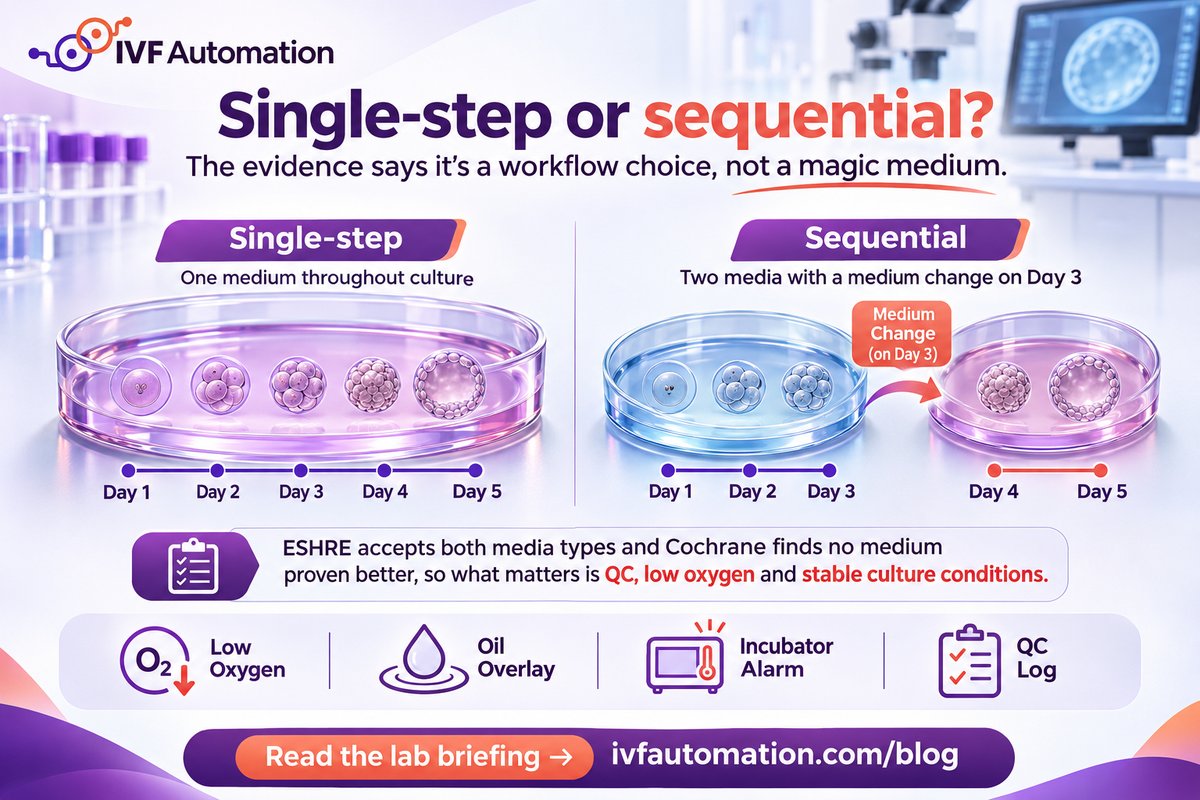
No single-step or sequential culture medium has been shown to be clearly better than the other. Randomised trials find no difference in ongoing pregnancy, and ESHRE's lab guideline accepts either. For a lab manager the real decision is about workflow, stable conditions and how well you can monitor and document them.
That makes “Novelties in embryo culture”, an invited session at ESHRE 2027, worth watching for operations reasons, not only science. Every new media formulation or incubator that follows will land in your lab as a purchase decision, a validation job and a change to the QC log. Here is what the evidence already says, so you can read the new claims against it.
What is the “Novelties in embryo culture” session at ESHRE 2027?
It is Invited session 11 on the ESHRE 2027 main programme, listed for Monday 5 July 2027, 17:00–18:00 CEST (20:30–21:30 IST). ESHRE's 43rd Annual Meeting runs from 4 to 7 July 2027 at Stockholmsmässan, Stockholm. Speakers and talk titles were not yet shown on the official main programme when we checked on 14 November 2026. In the same slot, Invited session 13 covers “New KPIs in reproductive healthcare”, which pairs well with our piece on automating a Vienna-consensus KPI dashboard. Dates for this and other meetings are on our IVF events calendar.
Single-step vs sequential culture media: which is better?
Neither has been shown to be superior for pregnancy outcomes. Sequential systems change the medium around day 3 to match the embryo's shifting needs; single-step (continuous) media are used from fertilisation to blastocyst without a full change. A 2016 systematic review and meta-analysis by Sfontouris et al. found no difference in ongoing pregnancy per randomised woman (RR 0.9, 95% CI 0.7 to 1.3; two trials, 246 women). Single-step media were linked to slightly higher blastocyst formation per oocyte or zygote, but not more top-quality blastocysts, and the evidence was rated very low quality. The authors concluded there is insufficient evidence to call either system superior, while noting single media have practical advantages.
The wider picture is the same. Cochrane's updated review of culture media (evidence to August 2025) included 26 studies, but no two compared the same media, so none could be pooled. One trial of 836 women found G5 probably gave more live births than HTF; most others found no clear difference. Its conclusion: insufficient evidence to support or refute any specific medium.
| Operational factor | Single-step | Sequential |
|---|---|---|
| Dish handling to day 5 | No full medium change needed | Medium change around day 3 |
| Fit with uninterrupted time-lapse culture | Natural fit | Dish must come out for the medium change |
| Media lots to track | One medium | Two media |
| Evidence on ongoing pregnancy | No difference shown in randomised trials | |
Does uninterrupted culture matter for workflow?
It reduces handling, which is what ESHRE asks labs to minimise. The ESHRE revised guidelines for good practice in IVF laboratories state that fluctuations of culture conditions should be minimised and that embryos should be distributed across incubators to minimise door openings. They also note that time-lapse imaging allows assessment “while not interfering with the embryo culture environment”. Pairing a single-step medium with a time-lapse or benchtop incubator is therefore mostly a workflow choice. Whether time-lapse improves outcomes is a separate question, covered in our time-lapse incubator buyer's guide.
Is low oxygen culture still the standard?
Yes for blastocyst culture: ESHRE says a low oxygen concentration should be used. The Cochrane review by Bontekoe et al. compared about 5% with atmospheric (about 20%) oxygen. It included seven trials (2,422 participants) and pooled four (1,382), finding a higher live birth rate with low oxygen (OR 1.39, 95% CI 1.11 to 1.76) and no evidence of more adverse events. The trials were of relatively low methodological quality. For operations, low oxygen means nitrogen supply, gas mixing and one more parameter to verify on every incubator.
What should a lab monitor and automate during culture?
Everything that can drift: temperature, gas, pH, air quality and the materials themselves. ESHRE's guideline asks labs to:
- continuously monitor critical equipment, including incubators, with alarm systems;
- set accepted ranges for every measured parameter, record readings and verify corrections;
- use oil overlay, which minimises changes to temperature, pH and osmolality;
- use quality-controlled media, oil and disposables, and keep products traceable;
- use high-purity gas, with inline HEPA and VOC filters highly recommended, and automatic backup power for critical equipment.
This is where automation pays off. Logger data, alarm acknowledgements and media lot numbers belong in one record, not on a clipboard. Our guide to daily IVF lab QC logs shows a simple structure, and the free Lab QC Logs tool lets you start today. Air quality has its own guide: VOC monitoring in the IVF lab.
How should an Indian lab evaluate a new culture product?
Treat it as a validated change, not a swap. Before switching media or incubators, ask:
- What exactly is claimed, and is there randomised live-birth evidence, or only lab endpoints?
- How will you validate it in your own lab, and against which baseline KPIs?
- Do lot numbers, expiry dates and QC certificates flow into your records automatically?
- Does it change gas, oil or handling steps that your SOPs and staff training must reflect?
Frequently asked questions
Is single-step culture medium better than sequential medium?
Not on current evidence. A 2016 meta-analysis of randomised trials found no difference in ongoing pregnancy, and ESHRE's lab guideline accepts either. The choice is mainly about workflow and QC.
Why do labs use low oxygen for embryo culture?
Around 5% oxygen is closer to conditions in the reproductive tract than atmospheric air (about 20%). ESHRE recommends low oxygen for blastocyst culture, and a Cochrane review favoured it, though the trials were of relatively low quality.
When is the Novelties in embryo culture session at ESHRE 2027?
It is Invited session 11, listed for Monday 5 July 2027, 17:00 to 18:00 Central European Summer Time (20:30 to 21:30 IST), at the ESHRE annual meeting in Stockholm.
What should an IVF lab log during embryo culture?
At minimum: incubator temperature and gas readings, alarms and how they were resolved, media and oil lot numbers, and who handled each dish and when. ESHRE asks for accepted ranges to be set and recorded.
Sources
- ESHRE. ESHRE 2027 main programme (Invited session 11: Novelties in embryo culture). Accessed 14 November 2026.
- ESHRE Guideline Group on Good Practice in IVF Labs. Revised guidelines for good practice in IVF laboratories (2015). Human Reproduction, 2016.
- Laverde M et al. Culture media for human pre-implantation embryos in assisted reproductive technology cycles. Cochrane review update, evidence to August 2025.
- Sfontouris IA et al. Blastocyst culture using single versus sequential media in clinical IVF: a systematic review and meta-analysis of randomized controlled trials. J Assist Reprod Genet, 2016;33:1261–1272.
- Bontekoe S et al. Low oxygen concentrations for embryo culture in assisted reproductive technologies. Cochrane Database of Systematic Reviews, 2012.
Your next step
Supply culture media, incubators or lab monitoring systems in India? Claim a free vendor listing so lab managers can find you when they shortlist.
General operational information only; not medical advice and no claim about clinical outcomes. Session details are as published by ESHRE on 14 November 2026 and may change. See our disclaimer.