
News
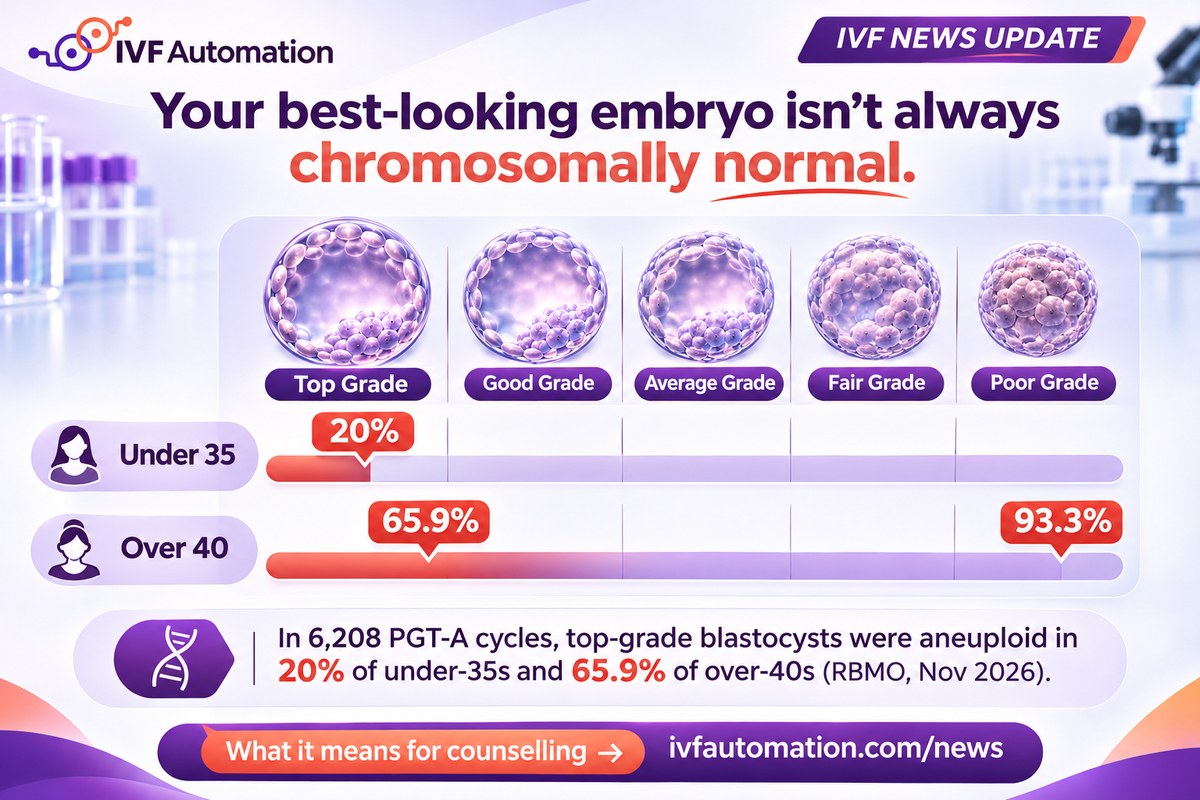
Top-grade embryos were still aneuploid in 1 in 5 under-35s and 2 in 3 over-40s, PGT-A study finds
· IVF Automation News
Summary
A retrospective study of 6,208 PGT-A cycles at ART Fertility Clinics in the UAE, published online in Reproductive BioMedicine Online on 13 November 2026, measured how often the embryo that looks best under the microscope is chromosomally abnormal. Top-quality blastocysts were aneuploid in 20% of women under 35 and 65.9% of women over 40. Risk rose steadily as grade fell. The authors say the figures can support more individualised counselling.
The embryo that looks best is not always the one with normal chromosomes, and age changes the odds a lot. A large new study from the UAE puts numbers on that gap. It gives labs and clinicians age- and grade-specific figures to use when they explain embryo selection to patients.
What did the study measure?
The team at ART Fertility Clinics in Abu Dhabi asked a simple question: if you pick an embryo for transfer on looks alone, how likely is it to be aneuploid? To answer it, they used cycles in which every graded blastocyst was also biopsied for PGT-A.
The study covered 3,716 patients and 6,208 cycles biopsied between July 2017 and December 2024. In 4,634 cycles there were several blastocysts to rank; in 1,574 there was only one. Blastocysts of grade BL3CC or better were ranked using a combined score of inner cell mass, trophectoderm and biopsy day. The main outcome was aneuploidy in the single blastocyst, or in the best-ranked one when there were several.
How often was the best-looking embryo aneuploid?
The risk climbed as grade fell and as age rose. The abstract reports these figures:
- Women under 35: 20% of top-quality blastocysts were aneuploid (128 of 639), rising to 51.7% for poor-quality ones (91 of 176).
- Women over 40: 65.9% of top-quality blastocysts were aneuploid (110 of 167), rising to 93.3% for poor-quality ones (446 of 478).
Compared with top-quality embryos, the relative risk of aneuploidy was 1.30 for good, 1.48 for fair and 1.72 for poor-quality embryos. The abstract reports a relative risk of 2.33 for women over 40 and describes this as more than double the risk of women under 35. In cycles with several embryos, the link between grade and aneuploidy held for the first, second and third-ranked embryo alike.
The authors say the results provide “clinically relevant, morphology- and age-specific estimates that support more individualized patient counselling.”
Why does morphology only partly track chromosomes?
Blastocyst grading scores how well the embryo has expanded and how its inner cell mass and outer cell layer look. These traits reflect growth and cell health, but a chromosome error does not always show on the surface. Earlier work, such as a 2014 two-centre study of 956 screened blastocysts in Human Reproduction, found that morphology and euploidy are linked but far from interchangeable. This new study adds scale and splits the risk by both grade and age.
What does this mean for embryologists and lab managers?
- Use the numbers in counselling. “Good-looking embryo” means very different things at 33 and at 42. Age- and grade-specific tables help set honest expectations, especially where PGT-A is not used.
- Audit your own data. These are one clinic group’s figures. Labs with PGT-A data can build the same table locally, which is also useful for KPI review.
- Keep grading consistent. The value of any such table depends on grading being reproducible between embryologists. Regular inter-observer checks matter.
- Judge AI tools fairly. A tool that claims to beat morphology should show gains on these age and grade groups, not just an overall score. This week’s 11,915-blastocyst time-lapse study found timing also misses many trisomies.
What is the angle for Indian and global clinics?
In India, PGT-A adds cost and is not used in every cycle, so morphology is often the main way an embryo is chosen. For older patients in particular, age-specific aneuploidy estimates are directly useful for consent and expectation-setting. Clinics should keep in mind that the figures come from a UAE population treated under one group’s protocols, and local data may differ. Globally, the study feeds the wider debate on when PGT-A is worth its cost, which we covered in our report on PGT-A funding reviews in Israel and Ontario.
Expert context
The authors are based at ART Fertility Clinics in Abu Dhabi and Dubai, with links to UZ Ghent, Koç University and the University of Kent. Co-authors include Baris Ata, Barbara Lawrenz, Erkan Kalafat and Human Fatemi. Ata and Kalafat also co-wrote a 2021 Fertility and Sterility paper that proposed defining recurrent implantation failure using expected aneuploidy rates by age, an approach that relies on the same kind of age-based estimates.
What is the commercial outlook?
For PGT-A providers, the data show how often good morphology alone still leads to an aneuploid transfer, especially over 40. For AI and imaging vendors, they set a clear, age-split baseline to beat. For clinic owners, the more immediate use is in counselling materials and in reviewing which patients are offered testing. Embryo selection is a recurring theme at meetings on our IVF events calendar.
What are the limits?
The study was retrospective and from a single clinic group. Only blastocysts graded BL3CC or better were included. PGT-A on a trophectoderm biopsy can misclassify some embryos, including mosaic ones. IVF Automation reviewed the abstract only; full methods and data were not available to us.
Sources
- Elkhatib I, Nogueira D, Bayram A, et al. Evaluating morphology-based embryo selection: aneuploidy risk in a large PGT-A cohort. Reproductive BioMedicine Online, published online 13 Nov 2026. https://doi.org/10.1016/j.rbmo.2026.106042
- Capalbo A, Rienzi L, Cimadomo D, et al. Correlation between standard blastocyst morphology, euploidy and implantation: an observational study in two centers involving 956 screened blastocysts. Human Reproduction, 2014. https://doi.org/10.1093/humrep/deu033
- Ata B, Kalafat E, Somigliana E. A new definition of recurrent implantation failure on the basis of anticipated blastocyst aneuploidy rates across female age. Fertility and Sterility, Nov 2021. https://doi.org/10.1016/j.fertnstert.2021.06.045
- Quintana-Vehí A, et al. Morphokinetic trajectories of 11,915 blastocysts reveal aneuploidy-specific effects on preimplantation development. Reproductive BioMedicine Online, online 12 Nov 2026. https://doi.org/10.1016/j.rbmo.2026.106073
Tags: embryo morphology, blastocyst grading, aneuploidy, PGT-A, maternal age, embryo selection, embryology lab, IVF research
Information only, not medical advice.