
News
‘Three-parent IVF’ is being sold to older women abroad. The evidence says it rarely helps
· IVF Automation News
Summary
An eight-month STAT investigation published on 2 November 2026 reports that mitochondrial replacement therapy (MRT), often called “three-parent IVF”, is being marketed to women in their 40s and early 50s at clinics outside the US, even though there is little evidence it helps age-related infertility. Unpublished data reviewed by STAT suggest the main problem in older eggs is the chromosomes, not the mitochondria. It is a test of how labs and clinics counsel and consent for add-ons.
MRT was developed for a narrow purpose: to stop mothers passing on serious diseases carried in mitochondrial DNA. STAT’s reporting shows a second market has grown around it, sold as a last chance for older women who want a genetically related child. STAT says hundreds of women have travelled to clinics in Eastern Europe, Mexico, the Bahamas, the Philippines and elsewhere over the past decade.
What is mitochondrial replacement therapy?
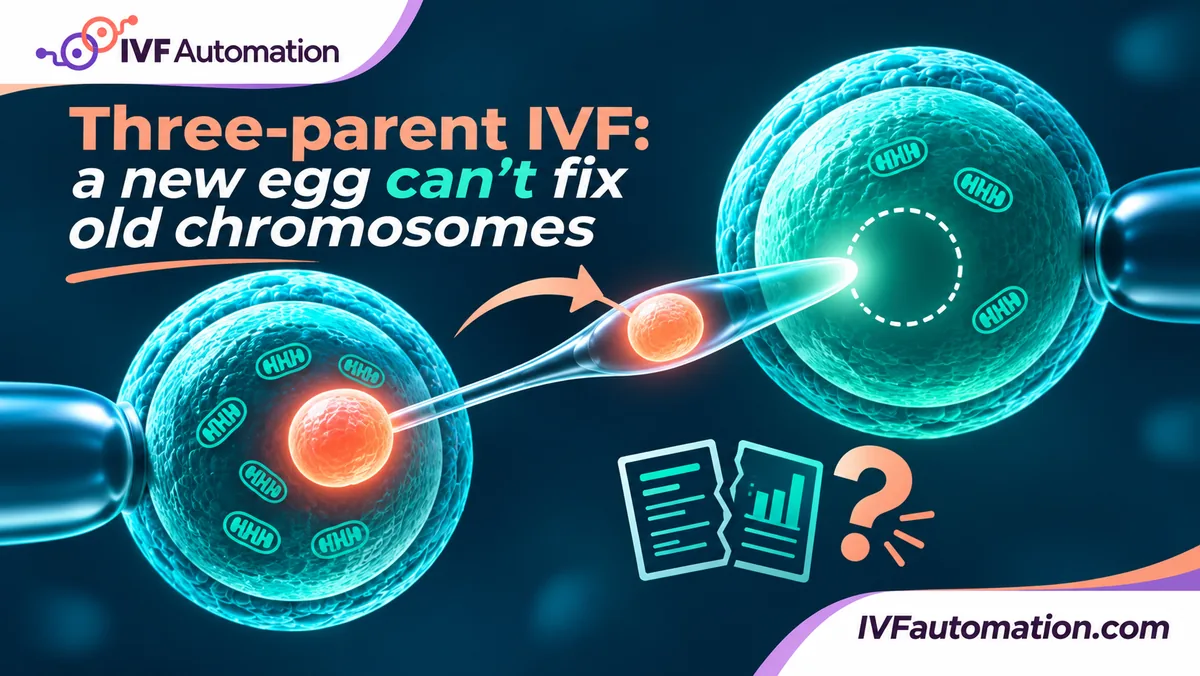
Mitochondria are the energy producers inside cells and carry a small genome of their own. In MRT, the nuclear DNA from the intended mother’s egg or embryo is moved into a donor egg or embryo whose own nucleus has been removed. In spindle transfer, embryologists use a polarised-light microscope to find and lift out the chromosome spindle before fertilisation. In pronuclear transfer, the swap happens just after fertilisation.
The idea behind the fertility use is that a younger donor egg will “power” the embryo better. The difficulty is that age-related decline is driven largely by chromosome errors in the egg (aneuploidy), which rise steeply after 40. A fresh supply of mitochondria does not repair the chromosomes.
What did STAT find?
- Marketing to older women: the US facilitator International Fertility Group of North America (IFG) connected clients with partner clinics abroad. A webinar slide reviewed by STAT showed the average age of patients in its mitochondrial donation programme rose from 39.2 years in 2022 to 45.6 years last year.
- Claims without published data: IFG said on its website that 34 babies had been born through its programme as of February 2025 and cited a pregnancy rate above 50% for MRT cycles, without substantiation. Neither IFG nor its partner clinics have published data in reputable peer-reviewed journals.
- Older women rarely benefited: unpublished results from Ukrainian embryologist Pavlo Mazur showed that, of 19 women aged 36 to 44 who had pronuclear transfer, only one obtained a single embryo with a normal chromosome count. When he did the reverse, moving young donors’ nuclear DNA into older women’s eggs, 40% of embryos reached a transferable stage and 70% of those were chromosomally normal. That points to the nucleus, not the mitochondria, as the problem.
- Changes since STAT asked questions: IFG paused new MRT patients after STAT’s inquiries began in July, and in the week before publication removed all mention of MRT from its website. It told STAT it is not a clinic, does not perform procedures and does not promise any outcome.
How do regulators and professional bodies treat MRT?
In the US, a spending rider passed by Congress in 2015 stops the FDA from even acknowledging applications for clinical trials that modify human embryos, so MRT is effectively unavailable there. In the UK, it is approved case by case, and only the Newcastle clinic has been permitted, and only to prevent mitochondrial disease. Newcastle reported in July 2025 that eight babies had been born to seven women after pronuclear transfer, with no signs of mitochondrial DNA disease.
ESHRE’s 2023 recommendations on add-ons call MRT experimental, find insufficient evidence of benefit or safety, and say it should only be used in strict research protocols with long-term follow-up of children. MRT “to affect oocyte quality is not recommended.”
What does this mean in India?
We found no Indian reports tied to the STAT findings. India’s ART (Regulation) Act, 2021 is still the relevant frame for anything involving donor eggs. It requires every ART clinic and bank to be registered (section 15) and limits services to women aged 21 to 50 (section 21). It also requires written informed consent from all parties and insurance cover for the oocyte donor (section 22), and allows a woman to donate eggs only once in her life, with no more than seven oocytes retrieved (section 27). Clinics that get questions about MRT from patients who have seen overseas advertising should explain these rules and the evidence gap. Our ART Act lab compliance checklist covers the paperwork in detail.
What should embryologists, lab managers and clinic owners do?
- Counsel on the real age barrier. Patients in their 40s need a clear explanation that egg aneuploidy, not “tired mitochondria”, is the main reason success falls with age.
- Hold every add-on to the same standard. Ask for published, peer-reviewed outcome data before offering any add-on. The same question came up with embryo glue.
- Keep the records tight. STAT describes poor record keeping at one MRT clinic. Witnessing, chain of custody and consent records protect patients and the clinic; see our witnessing guide.
- Check referral partners. Know what any overseas partner or facilitator promises your patients.
What is the commercial outlook?
MRT is unlikely to become a mainstream fertility service soon. Regulators and professional bodies treat it as experimental, and the one licensed UK programme is limited to preventing disease. What the STAT investigation will probably do is increase scrutiny of how fertility add-ons are sold. Clinics and lab-tech suppliers that can show transparent outcome data are likely to fare better under that scrutiny.
This article reports journalism, research and regulation. It is not medical, financial or legal advice.
Sources
- Megan Molteni, “Women travel thousands of miles for a reproductive moonshot. Scientists say they’ve been misled”, STAT, 2 Nov 2026 (investigative report). https://www.statnews.com/2026/11/02/three-parent-ivf-fertility-tourism-investigation-mrt-therapy/
- ESHRE Add-ons Working Group, “Good practice recommendations on add-ons in reproductive medicine”, Human Reproduction 38(11):2062–2104, 2023 (professional recommendations). https://pmc.ncbi.nlm.nih.gov/articles/PMC10628516/
- Newcastle upon Tyne Hospitals NHS Foundation Trust, “Eight babies born after mitochondrial donation treatment to reduce transmission of mitochondrial DNA disease”, 16 Jul 2025 (news release on two NEJM papers). https://www.newcastle-hospitals.nhs.uk/news/eight-babies-born-mitochondrial-donation-treatment/
- Government of India, The Assisted Reproductive Technology (Regulation) Act, 2021, sections 15, 21, 22 and 27 (statute, via PRS Legislative Research). https://prsindia.org/files/bills_acts/acts_parliament/2021/The%20Assisted%20Reproductive%20Technology%20(Regulation)%20Act,%202021.pdf
Tags: mitochondrial replacement therapy, three-parent IVF, MRT infertility, spindle transfer, pronuclear transfer, fertility tourism, IVF add-ons, advanced maternal age IVF, ART Act India