
CASA sperm analysis in IVF labs: what WHO 2021 says, accuracy limits and buying checks
Published 30 October 2026 · IVF Automation · Andrology lab automation
CASA (computer-aided sperm analysis) uses a camera and software to measure sperm concentration, motility and movement automatically. Research shows it agrees well with manual counts for concentration and motility in mid-range samples, but the WHO 2021 manual still treats it mainly as a research tool and insists on trained staff and strict quality control. For an Indian IVF lab, CASA is a standardisation tool, not a replacement for the andrologist.
Semen analysis is often the busiest test in an IVF centre, and manual counts vary from one technician to the next. That is why CASA vendors promise speed and objectivity. Before you sign a purchase order, it helps to know what the evidence and the WHO manual actually say, and which checks protect your results.
What is CASA sperm analysis?
A CASA system is a microscope, camera and software that detects sperm in a counting chamber and tracks their movement frame by frame. The WHO manual says CASA is best used for kinematic analysis, because it can detect and analyse motile cells. Typical outputs include concentration, percentage motility and velocity measures such as curvilinear velocity (VCL), straight-line velocity (VSL) and amplitude of lateral head displacement (ALH). Some systems add morphology analysis on stained slides, which WHO calls computer-aided sperm morphometric assessment (CASMA).
What does the WHO 2021 manual say about CASA?
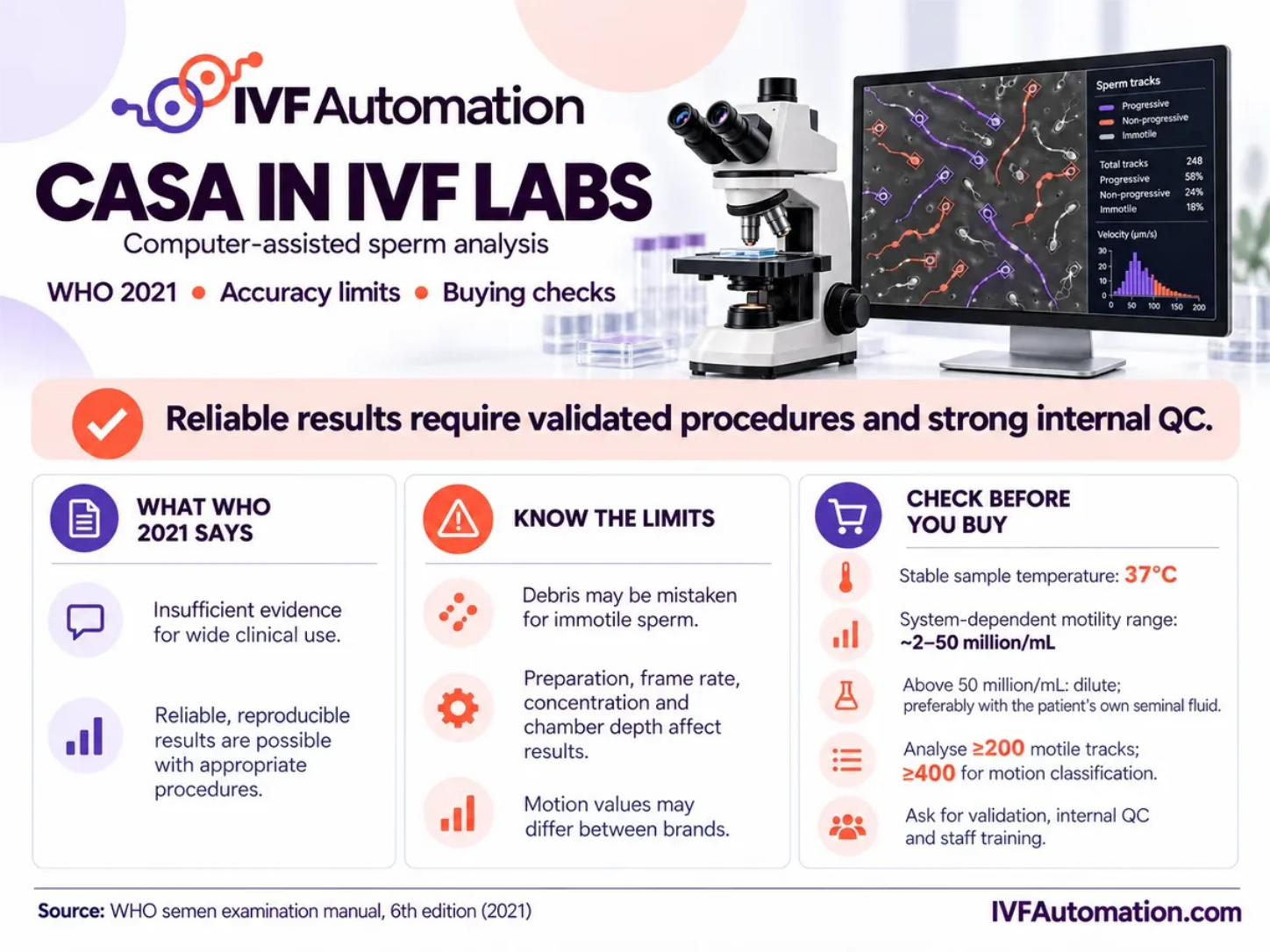
The sixth edition rewrote the CASA section to describe its principles and its use as a research technology. It states that there is still not enough evidence to allow CASA in wide clinical practice, and that a lack of internal QC can lead to many errors between systems and laboratories. It also says reliable, reproducible results can be obtained if appropriate procedures are followed. Key points for lab managers:
- Percentage motility may be unreliable, because debris can be confused with immotile sperm.
- Results depend on sample preparation, frame rate, sperm concentration and counting-chamber depth.
- The system must hold the sample at a stable 37 °C.
- Motility can be calculated at concentrations of roughly 2 to 50 million/mL, depending on the system; samples above 50 million/mL should be diluted, preferably with the patient's own seminal fluid.
- At least 200 motile sperm tracks should be analysed per specimen, and 400 if you classify motion types.
- Different instruments use different algorithms, so movement values may not be comparable between brands.
Is CASA as accurate as manual semen analysis?
For concentration and motility in mid-range samples, mostly yes; for extreme concentrations, dirty samples and morphology, less so. A 2021 systematic review in Translational Andrology and Urology (Finelli et al.) included 14 studies. It found a high degree of correlation between manual and CASA results for concentration and motility. CASA showed more variability in samples below 15 million/mL and above 60 million/mL, motility was inaccurate in high-concentration samples or with non-sperm cells and debris, and morphology showed the largest differences. The authors called CASA a valid alternative for concentration and motility, but said trained personnel are still needed, because mixing, loading, cleaning and calibration remain human tasks. High agglutination also limited some systems.
Can CASA assess sperm morphology?
Yes, but only with highly standardised staining. WHO notes that automated morphology can be more objective and reproducible than manual scoring, yet focus, illumination, preparation and staining can easily bias results. It also notes difficulty separating sperm heads from debris when concentration is low, and suggests automated staining as a sensible pairing. If morphology is your main reason to buy, ask to see results on your own stained slides.
What QC and documentation should a CASA lab keep?
Verify the installation, train every user, and run QC with recorded material, then log it like any other lab instrument. WHO says users should verify that the tool works even when the manufacturer sets it up, that suitable QC material such as video recordings is essential, and that labs should follow the manufacturer's QC procedures, often replaying stored images of sperm moving at known velocities. ISO 23162:2021 sets minimum requirements for basic semen examination and also covers sample preparation for CASA; ISO lists it as under systematic review since July 2026. Record CASA QC alongside your daily lab QC logs, or use our free Lab QC Logs tool.
What should Indian labs check before buying a CASA system?
Check regulatory status, validation on your own samples, QC tools, data export and service.
- CDSCO status. CDSCO's list of IVD analysers under the Medical Devices Rules, 2017 classes the spermatozoa/semen analyser as Class A. Ask the vendor for its manufacturing or import licence or registration details.
- Side-by-side validation. Run a batch of your own samples, including low counts and high-debris samples, by trained manual counting and CASA, and compare.
- Concentration range and dilution. Ask which range the system handles and how it prompts dilution.
- QC material. Confirm it ships with QC videos or beads and logs QC results.
- Temperature control. Confirm a heated stage holding 37 °C.
- Data export. Results should flow into your IVF EMR or LIMS and KPI dashboard, not be retyped.
- Service and AMC. Use our equipment AMC questions for calibration visits and spare parts.
CASA measures samples; choosing a sperm for ICSI is a different task, covered in our robotic ICSI and AI sperm selection guide. WHO also notes that smartphone-based devices cannot yet achieve the quality needed for a full semen analysis.
Frequently asked questions
What is CASA sperm analysis?
CASA (computer-aided or computer-assisted sperm analysis) uses a microscope, camera and software to detect spermatozoa and measure their concentration, motility and movement, and in some systems morphology, from digitised images.
Is CASA as accurate as manual semen analysis?
For concentration and motility, a 2021 systematic review of 14 studies found high correlation with manual analysis, but more variability below 15 and above 60 million/mL, errors with debris, and the largest differences for morphology.
Does WHO recommend CASA for routine semen analysis?
The WHO 2021 manual describes CASA mainly as a research technology and states there is still not enough evidence for its use in wide clinical practice, while noting reliable results are possible when proper procedures and QC are followed.
Is a semen analyser regulated by CDSCO in India?
Yes. CDSCO's list of IVD analysers under rule 4(2) of the Medical Devices Rules, 2017 includes the spermatozoa/semen analyser as a Class A in vitro diagnostic medical device.
What QC does a CASA system need?
WHO says each unit must be correctly installed and verified, staff must be trained, and suitable QC material such as video recordings is essential, following the manufacturer's QC procedures.
Sources
- World Health Organization, WHO laboratory manual for the examination and processing of human semen, sixth edition (2021), sections 1.3, 4.5 and 7.
- Finelli R, Leisegang K, Tumallapalli S, Henkel R, Agarwal A. The validity and reliability of computer-aided semen analyzers in performing semen analysis: a systematic review. Transl Androl Urol 2021;10(7):3069–3079.
- ISO, ISO 23162:2021 Basic semen examination: specification and test methods.
- CDSCO, List of In-Vitro Diagnostic Medical Devices (IVD Analyzers) under rule 4(2) of the Medical Devices Rules, 2017, and the CDSCO in vitro diagnostics page.
Your next step
CASA, andrology and semen analyser vendors can claim a free listing in our vendor directory, so Indian IVF labs comparing systems can find you.
General operational information only; not medical, clinical or legal advice. Product and company names are mentioned for information and are not endorsements. See our disclaimer.